


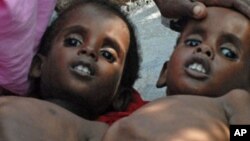
It has been a year since one of the worst droughts and subsequent famines in East Africa ravaged the Horn of Africa last year.
Humanitarian aid workers are still seeing refugee camps bursting at the seams as about one million people are living outside of their place of origin. For many families, especially children, survival is a daily struggle.
For one aid worker originally from Kenya, the situation brings back memories of a time in her young life when hunger was a daily occurrence. Amanda Koech, a Somalia representative for World Vision, reflected on the Kenyan drought in 1984.
“I was about five years old, but I vividly remember going through that experience,” said Koech. “There were five of us then: five children and two parents. We lived in the Rift Valley province of Kenya. Those were the longest days I have ever experienced in my life.”
She said there was little for her and her family to do at the time.
“It was because they wanted us to keep down the activities, to not lose energy. But food was a big, big problem. We could only access one meal per day. It was pap made out of sorghum. Sometimes it was made out of corn. But meals were very few,” reflects Koech.
However, during that period, the Kenyan government and humanitarian agencies were better able to reach hungry families with needed food and assistance, largely by setting up distribution centers.
Today, insecurity and logistical problems are preventing humanitarian agencies from reaching all of those in need.
“The drought last year in Somalia is the worst I have seen in my lifetime, mainly because I met mothers and children in displacement—they didn’t know whether they were going to get food at all,” said Koech.
She added she has never seen such a large a number of malnourished children.
As of today about 1.5 million people may join the already 2.5 million still in need of assistance said Koech. In addition, 332,000 children under the age of five around the country are malnourished.
The Dolo Ado area near the southern border of Somalia is at high risk with a malnutrition rate of 22% said Koech, who added, “We are very worried.” Hear entire interview with Amanda Koech and Kim Lewis.
Humanitarian aid workers are still seeing refugee camps bursting at the seams as about one million people are living outside of their place of origin. For many families, especially children, survival is a daily struggle.
For one aid worker originally from Kenya, the situation brings back memories of a time in her young life when hunger was a daily occurrence. Amanda Koech, a Somalia representative for World Vision, reflected on the Kenyan drought in 1984.
“I was about five years old, but I vividly remember going through that experience,” said Koech. “There were five of us then: five children and two parents. We lived in the Rift Valley province of Kenya. Those were the longest days I have ever experienced in my life.”
She said there was little for her and her family to do at the time.
“It was because they wanted us to keep down the activities, to not lose energy. But food was a big, big problem. We could only access one meal per day. It was pap made out of sorghum. Sometimes it was made out of corn. But meals were very few,” reflects Koech.
However, during that period, the Kenyan government and humanitarian agencies were better able to reach hungry families with needed food and assistance, largely by setting up distribution centers.
Today, insecurity and logistical problems are preventing humanitarian agencies from reaching all of those in need.
“The drought last year in Somalia is the worst I have seen in my lifetime, mainly because I met mothers and children in displacement—they didn’t know whether they were going to get food at all,” said Koech.
She added she has never seen such a large a number of malnourished children.
As of today about 1.5 million people may join the already 2.5 million still in need of assistance said Koech. In addition, 332,000 children under the age of five around the country are malnourished.
The Dolo Ado area near the southern border of Somalia is at high risk with a malnutrition rate of 22% said Koech, who added, “We are very worried.” Hear entire interview with Amanda Koech and Kim Lewis.
