



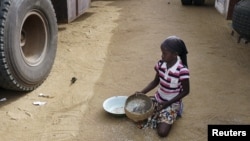
GENEVA — The World Food Program says it is scaling up its humanitarian operation in West Africa’s Sahel region to assist 10 million people critically short of food. WFP says among the beneficiaries will be 1.3 million people in Mali, including 300,000 internally displaced within the country.
In April, the government of Mali estimated that almost three million people living in drought-affected areas were food insecure. More recently, the WFP estimated that 1.6 million people in the regions of Gao, Kidal, Timbuktu and parts of Mopti are thought to be at risk of severe food insecurity, due to recent conflict in which rebels seized control of all of northern Mali.
WFP spokeswoman Elizabeth Byrs says food distributions are ongoing in drought-affected areas in southern Mali but that need in the rebel-controlled north is huge.
WFP staffers, however, are not allowed to go to the northern towns because of the security situation, she said, explaining that WFP is instead working with local non-governmental agencies to provide food to the vulnerable people in that part of the country.
“The rebel occupation in the northern area of Mali has exacerbated an already very precarious food security situation," she said. "We estimate that 340,000 people have been displaced internally and also fled into neighboring countries, [which] is why the situation is of concern.”
In June, WFP launched a system of cash transfers in Mali for the first time. As part of a pilot program that aims to reach 45,000 people in the western region of Koulikoro, Byrs says each household receives around $50 a month, which it can spend as it sees fit.
The program's initial two-month phase, if it proves successful, says Byrs, will be expanded to other regions.
“It is better to have a cash transfer program because each family can buy what they need and what they like," she said. "They can buy local food and it boosts [the] local economy. It's better than just distributing the food rations and [the] household can also buy exactly what [its inhabitants] need according to their food habits and their culture."
Besides food shortages, WFP says people in some parts of the Sahel also are being threatened by a possible plague of locusts. WFP says there have been reports over the past two weeks that swarms of desert locusts are moving southward from Algeria and Libya.
It says locust-control efforts are being hampered by insecurity in the region, because experts and control teams are having difficulty accessing affected areas. The World Food Program warns that the arrival of locusts would lead to devastation of fodder and crops, exacerbating the food situation in the Sahel.
In April, the government of Mali estimated that almost three million people living in drought-affected areas were food insecure. More recently, the WFP estimated that 1.6 million people in the regions of Gao, Kidal, Timbuktu and parts of Mopti are thought to be at risk of severe food insecurity, due to recent conflict in which rebels seized control of all of northern Mali.
WFP spokeswoman Elizabeth Byrs says food distributions are ongoing in drought-affected areas in southern Mali but that need in the rebel-controlled north is huge.
WFP staffers, however, are not allowed to go to the northern towns because of the security situation, she said, explaining that WFP is instead working with local non-governmental agencies to provide food to the vulnerable people in that part of the country.
“The rebel occupation in the northern area of Mali has exacerbated an already very precarious food security situation," she said. "We estimate that 340,000 people have been displaced internally and also fled into neighboring countries, [which] is why the situation is of concern.”
In June, WFP launched a system of cash transfers in Mali for the first time. As part of a pilot program that aims to reach 45,000 people in the western region of Koulikoro, Byrs says each household receives around $50 a month, which it can spend as it sees fit.
The program's initial two-month phase, if it proves successful, says Byrs, will be expanded to other regions.
“It is better to have a cash transfer program because each family can buy what they need and what they like," she said. "They can buy local food and it boosts [the] local economy. It's better than just distributing the food rations and [the] household can also buy exactly what [its inhabitants] need according to their food habits and their culture."
Besides food shortages, WFP says people in some parts of the Sahel also are being threatened by a possible plague of locusts. WFP says there have been reports over the past two weeks that swarms of desert locusts are moving southward from Algeria and Libya.
It says locust-control efforts are being hampered by insecurity in the region, because experts and control teams are having difficulty accessing affected areas. The World Food Program warns that the arrival of locusts would lead to devastation of fodder and crops, exacerbating the food situation in the Sahel.