


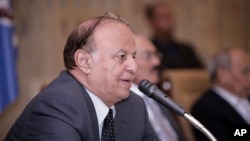
As Yemen transitions towards democracy, it is organizing a presidential election with only one likely candidate: Vice President Abd-Rabbu Mansour Hadi.
And that idea is drawing wide support from opposition parties and Yemen's diplomatic partners. For months, they have been pushing for the replacement of President Ali Abdullah Saleh, who recently agreed to end his 33-year rule after months of protests against him.
Analysts say those with interests in Yemen's future have differing motives for backing an uncompetitive democratic process. The election is scheduled for February.
'Neutral figure'
In the view of Yemen's opposition coalition, known as the Joint Meeting Parties, Hadi is a neutral figure who played no role in Saleh's violent crackdown on opposition protesters.
The 66-year old former army commander is a southerner who sided with President Saleh, a northerner, in a 1994 civil war and helped to defeat a southern rebellion. Hadi was rewarded with the vice presidency, but the post lacked influence until the president's political demise this year.
|
Interview with Ibrahim Sharqieh:
|
Ibrahim Sharqieh, deputy director of the Brookings Doha Center, said Hadi also benefited from a brief stint as acting president while Saleh received medical treatment in Riyadh for wounds suffered in a June bomb attack in Sana'a.
"Hadi worked with the opposition closely and earned their trust," he said.
GCC plan
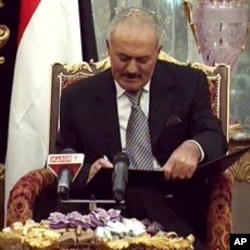
Saleh agreed last month to transfer his powers to Hadi as part of a Gulf Cooperation Council plan to ease the president from office. The Joint Meeting Parties also approved the transfer, which activated a constitutional law requiring a new president to be elected in 90 days.
London-based Middle East analyst Ginny Hill of Chatham House said the parliamentary opposition wants to elect Hadi because it sees him as the best person to lead discussions of political reforms that Saleh long resisted.
|
Interview with Ginny Hill:
|
Hill said the opposition coalition believes the 90-day pre-election period is far too short for discussions about increasing parliamentary powers, abolishing the presidency and introducing a federal system of government.
She said Yemeni opposition parties also realize there is not enough time before February to update years-old voter lists that exclude many people who have reached the voting age.
Presidential term
As part of the transition deal, the Joint Meeting Parties won a pledge from the ruling General People's Congress to limit Hadi's presidential term to two years.
|
Interview with Robert Powell:
|
Robert Powell, a Middle East expert at the Economist Intelligence Unit in New York, said both sides know they must use those two years to pass constitutional and electoral reforms. "You cannot really have a competitive election until all of these are in place," he said.
Hadi also would seem to be the preferred Yemeni leader of Saudi Arabia and the United States. Both nations want a change in the presidency, but not in the government's structure or military institutions - especially in light of the world terror threat coming from al-Qaida backed elements within Yemen.
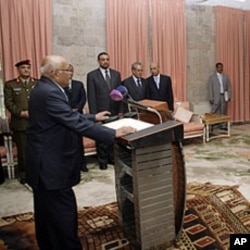
Under the Gulf Arab plan, a transitional cabinet will govern Yemen until the election, with Saleh's party controlling half of the ministries including defense and opposition members in charge of the rest.
"The United States does not trust the opposition to be an alternative to Saleh's regime," analyst Sharqieh said. "Washington is motivated by the fight against al-Qaida and so far, Saleh's regime proved itself to be the real ally in fighting al-Qaida in Yemen."
Keeping Yemen stable
Powell said the main aim of the United States and neighboring Gulf nations is to keep Yemen as stable as possible.
"They want nothing of the sort of disorderly regime change that we saw in Tunisia, Egypt and Libya," he said. "What they want is something that remains within the Yemeni constitution."
Still, many of the youth activists who led anti-Saleh protests are angry about the transition deal because they see it as keeping power in the hands of corrupt establishment politicians.
Youth movement
Hill of Chatham House said there is nothing to stop the youths from challenging Hadi by nominating their own presidential candidate. But she said the youth movement is diverse and has not been able to agree on a figurehead.
Brookings expert Sharqieh said the youths also have the option of boycotting the election and continuing their street protests.
Power struggle
Hill said Hadi's expected win in February is of less importance than the fate of a long-running power struggle between Yemen's military and tribal commanders.
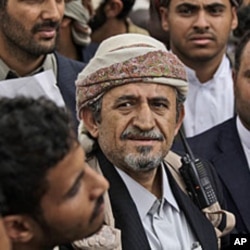
Control of Sana'a is divided between the elite Republican Guard led by President Saleh's son Ahmed, troops loyal to anti-Saleh General Ali Mohsen al-Ahmar, and militiamen commanded by tribal chief Sheik Sadeq al-Ahmar.
Sharqieh said the key element of the GCC transition plan is the formation of a military commission to restructure the fractured security forces. Hadi appointed the 14-member panel of opposition and loyalist generals this month.
EIU expert Powell said the commission will struggle to impose its decisions on Yemen's power brokers. He said it may have to appeal to Saudi Arabia, the West and the United Nations to support those decisions and provide financial incentives to bring rival generals on board.
"The committee itself is not an answer, but it at least provides a way ahead to reach decisions. Implementation will be probably the most difficult task," Powell said.
| Join the conversation on our social journalism site - Middle East Voices. Follow our Middle East reports on Twitter and discuss them on our Facebook page. |