



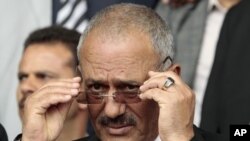
Yemeni government officials say President Ali Abdullah Saleh has agreed to a proposal from Gulf Arab mediators that calls for him to transfer power and resign within 30 days.
Officials said Saturday that the government had informed the six-nation Gulf Cooperation Council (GCC) of President Saleh's acceptance of the plan, which calls for him to leave office after 30 years of rule. In exchange, Mr. Saleh, his family and senior aides will be granted immunity from prosecution.
The plan also calls for President Saleh to transfer power to a deputy, who would then call presidential elections. The plan also sought to form a unity government in which ruling party members would hold half the seats, 40 percent would be held by an opposition coalition, with the rest made up of unaffiliated parties.
GCC Secretary-General Abdullatif al-Zayani presented the plan to Mr. Saleh on Thursday, in a bid to end Yemen's anti-government unrest.
A coalition of seven opposition parties said they also accepted the deal but with reservations. The opposition leaders refused to join the unity government while Mr. Saleh was still in office.
Meanwhile, many Yemenis across the country observed a general strike on Saturday to protest against President Saleh's rule. Some gathered for peaceful protests.
U.S. State Department spokesman Mark Toner said Washington welcomes the proposal for ending the crisis and called for immediate dialogue by all sides on a transfer of power.
On Friday, thousands of opposition activists rallied across Yemen, where they repeated calls for President Saleh's immediate resignation.
On Saturday, President Saleh accused his opponents of trying to drag the country into civil war. He also called former ruling party members who had resigned and joined the opposition "symbols of corruption."
He commented during a speech to armed forces academy students in Sana'a.
Some information for this report was provided by AP.