



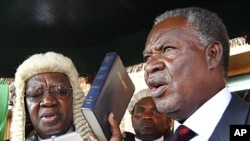
A prominent Zambian religious leader has called on President Michael Sata’s government to work with the nation’s churches to eliminate corruption.
The Reverend Suzanne Matale, general secretary of the Council of Churches in Zambia, said if such a partnership is to work, the government needs to establish goals and benchmarks to measure progress in the fight against corruption.
Her comments came after President Sata challenged the Council of Churches to help fight corruption in the country.
“This is something that we have always welcomed - to partner with the government of the day on issues that would bring dignity to the people in Zambia,” said Matale, who is also a Presbyterian minister. “And definitely, the issue of corruption has been an issue that we as church leaders have openly declared war against.”
She said there is evidence that corruption is a factor in keeping the nation poor and that corruption also takes away resources that would be used to help the poor.
"We have identified over the years that indeed we as a church have the responsibility to ensure that we participate in ensuring that this corruption is curbed,” Matale said.
Some Zambians have warned that a partnership between the church and the government to fight corruption might tarnish the church’s image if there were no progress in reducing deep-rooted corruption. Matale disagrees.
“Our partnership with government should not be at any time [be] construed to be complicity,” she said. “Because that is the problem we have in our nation - that when you declare that you want to partner with the government, immediately arrows start to be thrown at the church, thinking that the church has been compromised, but that is not our take on this one.”
Matale said working together with the government is the best way forward because the churches and the government both want to eliminate graft.
“And therefore as much as it’s our responsibility to preach accountability, transparency, honesty in our pulpits, this effort must be matched with benchmarks from the government,” she said.
Matale also called on the government to ensure that institutions like the anti-graft commission are allowed to function independently without any political interference.
The Reverend Suzanne Matale, general secretary of the Council of Churches in Zambia, said if such a partnership is to work, the government needs to establish goals and benchmarks to measure progress in the fight against corruption.
Her comments came after President Sata challenged the Council of Churches to help fight corruption in the country.
“This is something that we have always welcomed - to partner with the government of the day on issues that would bring dignity to the people in Zambia,” said Matale, who is also a Presbyterian minister. “And definitely, the issue of corruption has been an issue that we as church leaders have openly declared war against.”
She said there is evidence that corruption is a factor in keeping the nation poor and that corruption also takes away resources that would be used to help the poor.
"We have identified over the years that indeed we as a church have the responsibility to ensure that we participate in ensuring that this corruption is curbed,” Matale said.
Some Zambians have warned that a partnership between the church and the government to fight corruption might tarnish the church’s image if there were no progress in reducing deep-rooted corruption. Matale disagrees.
“Our partnership with government should not be at any time [be] construed to be complicity,” she said. “Because that is the problem we have in our nation - that when you declare that you want to partner with the government, immediately arrows start to be thrown at the church, thinking that the church has been compromised, but that is not our take on this one.”
Matale said working together with the government is the best way forward because the churches and the government both want to eliminate graft.
“And therefore as much as it’s our responsibility to preach accountability, transparency, honesty in our pulpits, this effort must be matched with benchmarks from the government,” she said.
Matale also called on the government to ensure that institutions like the anti-graft commission are allowed to function independently without any political interference.
