



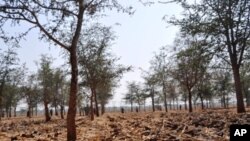
Zambia’s Conservation Farming Unit, the CFU, is promoting the planting of the Masangu tree, Faidherbia albida , as a way of boosting soil fertility and protecting the environment.
The tree is rich in nitrogen and other soil nutrients that farmers need to improve their yields.
Masangu is indigenous to Africa and grows in many places across the continent. A mature plant can produce up to 300 kilograms of fertiliser and 250 kilos of lime.
Food crops grown under the shade of the trees benefit from their annual leaf fall, which fertilizes the soil and counteracts soil acidity. The Conservation Farming Unit is encouraging farmers to plant 100 trees per hectare, at 10 metre intervals, as a long-term means of boosting soil fertility and improving yields.

More than 160,000 farmers have already begun. Collins Nkatiko is head of field operations at CFU. He says the use of the Masangu tree is not new in Zambia or elsewhere in Africa.
Nkatiko explains that the plant grows anywhere and people can collect the seeds from the wild. “We have [just begun planting] Faidherbia albida, which is a fertiliser factory within the field. This is a long-term measure,” Nkatiko says.
According to Nkatiko it will take time to enjoy the full benefits, because the tree has to grow. During that period farmers wait for the trees to grow and mature. “We give them fertilisers, and encourage them to use rotations with legumes, cereals and cash crops to ensure that they build up the fertility of their soils, ” Nkatiko explains.
For farmers to attain the full benefits of the Masangu tree, they will have to wait from seven to 15 years,” according to Nkatiko.
For decades, farmers around the world have cut down trees to create farmland. But with research, things are changing. Farmers are being encouraged to plant trees on their land as a way of preserving the environment and biodiversity.
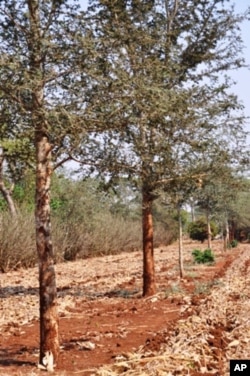
Chikondi Lillian Phiri an extension officer and trainer at CFU explains how planting trees in crop fields can boost soil fertility and crop production.
According to Phiri it is able to add about 75kg of nitrogen. It is also able to add a certain percentage of phosphate, iron. Magnesium oxide is added alongside with the calcium. So not only is it a fertility tree but it is also able to counteract the acidity in the soil because it has got liming effect with it.
"So with time, the dependence on synthetic fertiliser by the farmers will be reduced. The uniqueness with this tree is that during the rainy season, you will see it shedding off its leaves. So that effect of shading is not so much enhanced,” Phin asserts.
Agriculture research has shown that farmers who use trees and use the leaves as feed for their livestock also allow their animals to leave droppings in the field, yet another source of fertilizer.
This creates a chain of cost-effective opportunities that farmers across Africa can embrace.