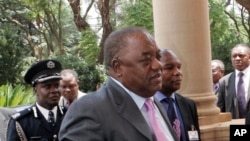
Zambia’s information minister says the government plans to ask parliament to cancel former president Rupiah Banda’s immunity from prosecution after he refused to talk with investigators from the country’s anti-graft commission.
“The government of Mr. Rupiah Banda is actually said to have been involved in massive plunder of our resources. He was invited to answer some allegations against him, but he refused,” said Information minister Kennedy Sakeni. “So government has no alternative rather than to lift his immunity. And that can be done by taking it to parliament as per our laws.”
Under the Zambia’s constitution, parliament is the only institution that can lift the immunity of a former head of state.
Sakeni also took a swipe at Zambia’s political opposition, saying it was creating tension and clashing with police.
At a recent joint press conference in South Africa, opposition leaders accused Zambian President Michael Sata’s government of stifling democracy and called for it to be suspended from the Commonwealth of Nations.
“The country is under assault, our democracy is under assault... The signs on the ground are very similar to what happened in Uganda with Idi Amin in terms of how the president and government is managing the opposition,” said Nevers Mumba, leader of the main opposition Movement for Multiparty Democracy (MMD).
Information minister Sakeni disagreed.
“The key point is that how do you hold a press conference outside your country on issues you can even raise within your country? Basically, I don’t understand what the motive is because the conditions in our country, I think we are the best among African countries in terms of good governance and the way we run public affairs,” said Sakeni.
“They peddled lies saying in this country they are not allowed to hold press conferences and that they are never allowed to hold public meetings. But barely three weeks ago, Mr. Hakainde Hichilema held a public rally in Lusaka though it was poorly attended,” he added.
Opposition political parties have accused the government of using state institutions to intimidate and harass their leaders, which they said tramples on their rights of free speech, assembly and association as enshrined in the constitution.
Sakeni counters by saying that opposition leaders have refused to respect the country’s laws.
“There are laws governing this country and when the police tell you that ‘please, do not hold this gathering today because we fear something bad might happen,’ why can’t you adhere to that? Why do you make a mystery out of a simple advice from the police?” asked Sakeni.
“The government of Mr. Rupiah Banda is actually said to have been involved in massive plunder of our resources. He was invited to answer some allegations against him, but he refused,” said Information minister Kennedy Sakeni. “So government has no alternative rather than to lift his immunity. And that can be done by taking it to parliament as per our laws.”
Under the Zambia’s constitution, parliament is the only institution that can lift the immunity of a former head of state.
Sakeni also took a swipe at Zambia’s political opposition, saying it was creating tension and clashing with police.
At a recent joint press conference in South Africa, opposition leaders accused Zambian President Michael Sata’s government of stifling democracy and called for it to be suspended from the Commonwealth of Nations.
“The country is under assault, our democracy is under assault... The signs on the ground are very similar to what happened in Uganda with Idi Amin in terms of how the president and government is managing the opposition,” said Nevers Mumba, leader of the main opposition Movement for Multiparty Democracy (MMD).
Information minister Sakeni disagreed.
“The key point is that how do you hold a press conference outside your country on issues you can even raise within your country? Basically, I don’t understand what the motive is because the conditions in our country, I think we are the best among African countries in terms of good governance and the way we run public affairs,” said Sakeni.
“They peddled lies saying in this country they are not allowed to hold press conferences and that they are never allowed to hold public meetings. But barely three weeks ago, Mr. Hakainde Hichilema held a public rally in Lusaka though it was poorly attended,” he added.
Opposition political parties have accused the government of using state institutions to intimidate and harass their leaders, which they said tramples on their rights of free speech, assembly and association as enshrined in the constitution.
Sakeni counters by saying that opposition leaders have refused to respect the country’s laws.
“There are laws governing this country and when the police tell you that ‘please, do not hold this gathering today because we fear something bad might happen,’ why can’t you adhere to that? Why do you make a mystery out of a simple advice from the police?” asked Sakeni.