News / Middle East

Obama: US Could 'Walk Away' From Iran Deal

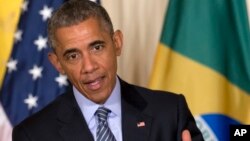
President Barack Obama speaks during his joint news conference with Brazilian President Dilma Rousseff, June 30, 2015, in the East Room of the White House in Washington.
Pamela Dockins

U.S. President Barack Obama said Tuesday that the United States would "walk away" from a possible nuclear deal with Iran if he is not convinced it would block Tehran's path to building a nuclear weapon.

"I will walk away from the negotiations if it is in fact a bad deal," he said. "There's still some hard negotiations to take place."

His comments came as negotiations in Vienna on Iran's nuclear program, which were under a Tuesday deadline, were extended for a week.

Obama said at a White House news conference that Iran must agree to a "strong, rigorous verification mechanism" on curbing its nuclear development program.

He said Tehran must live up to a framework agreement it reached earlier this year with the U.S. and five other world powers to allow inspectors to visit Iranian nuclear sites to verify that it is keeping its commitments.

"Ultimately this is going to be up to the Iranians," he said.

"My hope is they can achieve an agreement," he said during a news conference with Brazilian President Dilma Rousseff.

President Barack Obama on the Iran nuclear negotiationsi
X
July 01, 2015 12:18 AM
President Barack Obama said Tuesday that the United States would "walk away" from a possible nuclear deal with Iran if he is not convinced it would block Tehran's path to building a nuclear weapon.


Obama's comments came as the U.S., Germany, France, Russia, China and Britain extended negotiations with Iran in Vienna past their self-imposed Tuesday deadline for completing a deal.

The U.S. State Department says Iranian negotiators decided to extend until July 7 measures under the interim agreement to “allow more time” for talks on Iran's nuclear program to reach a long-term solution.
 
In November 2013, Iran and negotiators for the six world powers reached an interim agreement that required both sides to take specific steps while negotiators worked on a comprehensive deal. 

As talks continued, the two sides agreed to additional extensions and added more measures to the joint plan.

Iran delegation returns

In Vienna, the U.S. team met with the Russian delegation led by Foreign Minister Sergei Lavrov.

Iranian Foreign Minister Mohammad Javad Zarif returned to Vienna to rejoin the negotiations on Tuesday, the original self-imposed deadline for an agreement.
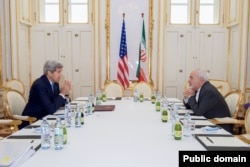
U.S. Secretary of State John Kerry sits across from Iranian Foreign Minister Javad Zarif on June 30, 2015, in Vienna, Austria, before a one-on-one meeting amid negotiations about the future of Iran's nuclear program. (Photo: State Department)

Zarif arrived with Iran’s nuclear chief, Ali Akbar Salehi, who has been recovering from illness, after returning to Iran for consultations Sunday.

Upon their return, Zarif met with U.S. Secretary of State John Kerry.

Kerry emerged from the talks saying, “We had a good conversation.”

According to Iranian state media, Zarif said the fact that Salehi had joined the talks, in spite of his illness, showed Iran’s seriousness about the negotiations.

He also said what was needed was the “political determination” of the world powers involved in the talks so that the two sides could reach “an acceptable and sustainable conclusion.”

WATCH: Pamela Dockins reports from the scene
Nuclear Talks Deadline Passes With No Deali
X
Pamela Dockins
June 30, 2015 4:29 PM
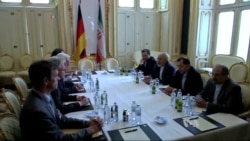
After months of intense negotiations, Iran and world powers have missed their self-imposed June 30 deadline for a final deal that restricts Tehran's ability to produce nuclear weapons in exchange for sanctions relief. As VOA State Department correspondent Pam Dockins reports from Vienna, analysts have mixed views on the impact of extending the talks.

Key Highlights of 2014 Nuclear Deal

- Two-thirds reduction of installed centrifuges

- No uranium-enrichment over 3.67 percent purity for 15 years

- No uranium-enrichment facilities for 15 years

- One-year bomb breakout (production) time 

- Fordow nuclear facility conversion; Arak reactor redesign

- Regular IAEA access

- Sanctions relief follows verified compliance

Midnight Tuesday had been the agreement deadline. Iran and the five permanent members of the U.N. Security Council and Germany, the so-called P5+1, have been seeking a deal that restricts Iran’s ability to produce nuclear weapons in exchange for sanctions relief.

Negotiators now predict talks could continue a few more days.

"This is staggeringly consequential for everybody," said a senior U.S. administration official in a Monday briefing.

"This is incredibly consequential for the national security of the United States. This is quite consequential for the national security of all of the P5+1 partners, the regions, the Middle East, the world and for Iran," the official added.

The official noted that what is currently under negotiation is considerably more detailed than the April 2 framework deal that set the parameters for a final agreement.
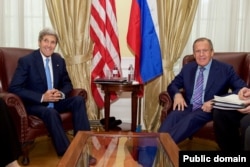
U.S. Secretary of State John Kerry shares a laugh with Russian Foreign Minister Sergey Lavrov on June 30, 2015, in Vienna, Austria, before a bilateral meeting amid P5+1 negotiations with Iranian leaders about the future of their nuclear program. (Photo: State Department)


Kerry-Lavrov meeting

Kerry is holding nuclear talks Tuesday with Russia's Lavrov.

Negotiators have been tight-lipped about details from the talks, but the sticking points are believed to include access that inspectors from the U.N.'s nuclear agency would have to Iranian sites as well as the pace at which sanctions against Iran would be lifted.

“The difficulty with any kind of a negotiation at this level is to keep it focused on the primary issue,” said General James Cartwright, a nuclear policy analyst with the Center for Strategic and International Studies.

“For me, focus on the primary issue is the ability to stop and end any type of uranium or plutonium enrichment cycle up to weapons grade,” Cartwright said.

There have also been concerns about managed access: how quickly International Atomic Energy Agency (IAEA) inspectors could be cleared to visit suspected sites.

In Monday’s briefing, the administration official said the world powers engaged in talks with Iran had added a procedure to the plan of action under discussion that would ensure that IAEA inspectors would get managed access when they believed they needed it.

Earlier Monday, Kerry led a delegation that met with Yukiya Amano, the director general of the International Atomic Energy Agency.

The Palais Coburg, venue of the Iran nuclear talks in Vienna, Austria, June 30, 2015. (Photo: Brian Allen / VOA)

Plea for detained American

On the sidelines of the nuclear talks Monday, family members of detained Iranian-American Amir Hekmati made a passionate plea for his return, urging Kerry and Iranian Foreign Minister Zarif to take up his plight during their talks.

Iranian officials arrested Hekmati in 2011 and charged him with espionage. He is one of three American citizens being held in Iran.

The senior administration official said that Kerry has had “direct” conversations with Zarif about the missing Americans and that U.S. officials work on their behalf on a daily basis.

Ken Bredemeier contributed to this report from Washington.

You May Like

What You Need to Know About Benghazi Hearing

House committee on Benghazi was created in May 2014 to investigate causes of and responses to attacks on two US sites More

Will Cricket Score Points with Americans?

All-star cricket teams will hold matches in US cities in an attempt to spark American interest in the sport, which enjoys enormous popularity outside the US More

What Americans Fear More Than Terrorism

Americans are more afraid of this than they are of potential terrorist attacks, according to a new fear survey More

This forum has been closed.
Comment Sorting
Comments
     
by: Godwin from: Nigeria
July 01, 2015 6:52 AM
Obama could walk away from the talks? That's quite intriguing. But it makes little sense since he's no action but talk. Tough talks like this would make alot of meaning coming from Ronald Regan, George Bush, Bill Clinton. They go to meeting with plan B, an 007-type action, like the one Nigeria's Chukwuma Kaduna Nzeogwu took while executing Nigeria's first ever coup: "If I go in there and not come out in 30 minutes, blow up the building - everything - and make sure nothing comes out of it!" I mean I've watched films like Bangkok Hilton and I understand what action means.

Which is what sense it makes having leaders with theatrical sense of action - something totally lacking in Obama. Question is , if Obama walks away from the Iran negotiations, where does he go and what does he do? Does he have plan B, or he walks to some corner to sulk? Sure he'll take anything to avoid the red-line tripping again. But he's the only hope of Iran's survival in the negotiation and the reason Iran can play pranks at such an important negotiation as this, and they want to enjoy it while Obama lasts in office. Everybody knows what it means if a George Bush etc. made that threat.

by: Lawrence Bush from: Houston; USA
July 01, 2015 3:19 AM
There's no chance now to walk away from the n-talks for our govt before the final settlement with Iran over its controversial n-program. If it's true the Iranians had started any such clandestine n-activities to make arsenals, that should come to the world fore. Besides, the P5 must endeavor to get Iran to proper non-proliferation track keeping focus upon the Iranian centrifuges limit for enriched fuel, the peaceful use of that.

by: MKhattib from: USA
June 30, 2015 6:50 PM
There is not way in hell Obama is going to walk away from this deal.He desperately wants a foreign policy win to turn around global perceptions of being a failure. We are at a point where US policy is veering dangerously off course and the end result will leave a deeply destabilized world with a nuclear-capable and flush with cash Iran still controlled by a small cadre of extremist mullahs.

by: Anonymous
June 30, 2015 6:34 PM
Iran believes lying and cheating are virtues, they have no intention of abiding by anything agreed to with the west. Its a ploy to have sanctions lifted. Let Israel settle the matter once and for all with force of arms.

by: Marcus Aurelius II from: NJ USA
June 30, 2015 10:59 AM
What is the point of negotiating with Iran when its supreme leader has just rejected many of the most critical items agreed to in the framework?

President Obama has committed to Iran not being able to acquire nuclear weapons. Not only Israel and Saudi Arabia but many thoughtful Americans including much of Congress are very concerned about how or even if President Obama will be able to keep this promise.

At best a nuclear armed Iran will touch off a nuclear arms race in the Mideast. At worst it will mean war, even nuclear war in pre-emptive strikes to stop Iran. What we've learned so far about these negotiations is very unsettling. There should be no mistake, the vital interests of America are on the line. The US failed to stop North Korea. Will this be a repeat of the same horrible blunder?

The last best hope would be the maximum sanctions the US could impose. Iran must be given a stark choice, give up its nuclear weapons program and open up to unfettered inspection to verify compliance or face imminent complete economic collapse. That is all their leaders can be made to understand.

by: Lawrence Weinerboner from: USA
June 30, 2015 10:02 AM
A complete SHAM that will AGAIN, accomplish NOTHING. Total charade, dog and pony show.
In Response

by: Eric L from: New Jersey
June 30, 2015 10:22 PM
Agreed - a last resolution on nuclear technology in the Middle East needs to bring Israel and the Gulf States to the table. I'd bet that is the sticking point now.

You show me yours, I'll show you mine.

Featured Videos

Your JavaScript is turned off or you have an old version of Adobe's Flash Player. Get the latest Flash player.
Drug Kingpin El Chapo Guzman Injured During Searchi
X
Alberto Pimienta
October 19, 2015 8:34 PM
Mexican authorities are closing in on the most dangerous drug trafficker in the world, Joaquin “El Chapo” Guzman. “El Chapo” avoided being captured over the weekend but the Mexican government says he’s now injured. VOA's Alberto Pimienta reports.
Video

Video Drug Kingpin El Chapo Guzman Injured During Search

Mexican authorities are closing in on the most dangerous drug trafficker in the world, Joaquin “El Chapo” Guzman. “El Chapo” avoided being captured over the weekend but the Mexican government says he’s now injured. VOA's Alberto Pimienta reports.
Video

Video Kenyan Town Vies to Become East African Cycling Hub

The sport of cycling has steadily built a following in East Africa in recent years. It doesn’t hurt that two-time Tour de France winner Chris Froome was born in Kenya and trained by one of Africa’s best cyclists, David Kinjah. And now the town of Machakos, about 56 kilometers southeast of Nairobi, is trying to become Kenya’s, and perhaps East Africa’s, cycling hub. VOA’s Jill Craig has more from Machakos, Kenya.
Video

Video Taliban Remain Serious Threat in Provinces Around Kunduz

Even though Afghan security forces have regained control of the northern city of Kunduz from the Taliban after fierce fighting, the security situation in the region is still tenuous. VOA’s Ayesha Tanzeem traveled to Baghlan Province, neighboring Kunduz, and has this report on the situation there.
Video

Video Taiwan Finding Niche Markets in China’s Shadow

China’s economy is like a business magnet and as its influence grows its neighbors are finding it increasingly difficult to remain competitive. Like many economies in the region, Taiwan has been hit hard in recent years as China’s so-called “red-supply chain” has drained off talent and opportunities.
Video

Video Amid Congressional Leadership Crisis, Momentous US Fiscal Deadlines Loom

The U.S. Congress faces critical fiscal deadlines at a time of upheaval and uncertainty on Capitol Hill. Lawmakers are returning from a weeklong recess still wondering who will lead the House of Representatives. Michael Bowman reports.
Video

Video Egyptians Vote in Long-delayed Parliamentary Election

Voting in a long-awaited election for a new parliament opened Sunday in half of Egypt's provinces as the government works to complete a roadmap to democracy implemented following the ouster of the country's first freely elected civilian President Mohamed Morsi of the Muslim Brotherhood.
Video

Video Reparations Underway for War Victims in Ivory Coast, Many Still Awaiting

Five years after the deadly 2010 post-election violence in Ivory Coast, the country is determined to consolidate its peace. And to help in that reconciliation, President Alassane Ouattara created agencies aimed at providing reparation for war victims. The first batch of victims was compensated last August. But many are still waiting, and some are losing patience over the lagging process. Emilie Iob reports.
Video

Video Inter-Korean Family Reunions Preparations Under Way

A South Korean advance team that includes Red Cross officials is now in North Korea to prepare for next week’s reunion for families that have been separated by the Korean War. VOA’s Brian Padden reports from Seoul that this rare reunion, that just weeks ago looked unlikely to happen, will offer the 200 selected participants the first opportunity to see their families in over half a century. And it could clear the way to further inter-Korean cooperation.
Video

Video Vets: Syria Not Another Afghanistan for Russia

Russia's military strikes in Syria against enemies of President Bashar al-Assad have raised fears of a proxy war against U.S.-armed rebels. The concerns echo the Soviet Union's 1979 intervention in Afghanistan. Russian veterans of the Afghan War, however, say a similar conflict in Syria is unlikely as long as ground troops are not involved. VOA's Daniel Schearf reports from Moscow.
Video

Video Largest US Prisoner Release to Begin Oct. 30

The United States is beginning its largest prisoner release in history, now that federal sentencing guidelines have been reduced for certain drug offenders. VOA's Carolyn Presutti talks to an inmate who is counting down the days to freedom — and the people who don't think he's yet to earn it.
Video

Video Syrian Refugees in US Struggle to Start Anew

Communities across the United States are welcoming Syrian refugees who have fled their war-torn country and often spent many months, if not years, in refugee camps. But, as VOA’s Greg Flakus reports from Houston, some of their biggest challenges come as they try to adapt to life in a new country.
Video

Video Turkey: Europe’s Offer of Migrant Deal ‘Insincere’

European Union leaders have agreed on a plan to offer Turkey $3.5 billion, together with visa-free travel and renewed accession talks, in return for stopping the flow of refugees and migrants into the EU. But as Henry Ridgwell reports from London, the offer is getting a lukewarm reception in Ankara.
Video

Video Amnesty Accuses Saudi Coalition of ‘War Crimes’ in Yemen

The human rights group Amnesty International has accused the Saudi-led coalition of war crimes in airstrikes against Houthi rebels in Yemen. Henry Ridgwell reports the group says hundreds of civilians have been killed in strikes on residential areas.

VOA Blogs