


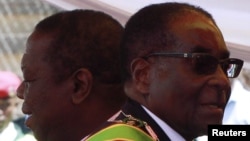
HARARE, Zimbabwe — In Zimbabwe, two new surveys show the popularity of President Robert Mugabe’s party is surging while that of Prime Minister Morgan Tsvangirai and his Movement for Democratic Change [MDC] is going down. Analysts say supporters of Tsvangirai have not been happy with his efforts in a fragile power-sharing government he formed three years ago with Mugabe’s ZANU-PF party.
Two surveys released by Freedom House and Afrobarometer on Friday said Mugabe’s ZANU-PF would win polls ahead of Tsvangirai’s MDC. The decline of the MDC party, which won the violence-marred 2008 elections, does not surprise Pedzisai Ruhanya, a media and democracy doctorate student at University of Westminster in London.
“When the MDC got into government their message was a message of change," said Ruhanya. "Change against what? Against bad leadership… against poor service… against corruption. But now there is corruption, there is bad leadership that we see in those that are in government on the side of the MDC. People are beginning to think, 'Is this the qualitative change we were looking at?' And they withdraw.”
The survey released by the Afrobarometer survey research project found that an election in Zimbabwe today would result in another coalition government, since there would be no outright winner.
In a telephone interview Rugare Gumbo, the spokesperson for ZANU-PF, said his party was empowering people, hence its swelling popularity.
“The resources of the country, which we are giving to our people… positively impact on ZANU-PF to [with] support,” said Gumbo.
The comment by Gumbo is a reference to the policies of "indigenizing" foreign-owned companies and seizing white-owned farmland that Mugabe’s party has supported.
The Afrobarometer survey - entitled “Voting Intentions in Zimbabwe: A Margin of Terror?” - said the violence that marred the 2008 polls remains an issue in the African country.
Douglas Mwonzora, the spokesperson for the MDC, said his party would defy findings of both the Freedom House and the Afrobarometer surveys.
“Yes, we have a number of disappointed people who thought that change was coming, who thought our getting into power with ZANU-PF was synonymous to running our government on our own. Those people will give us a chance to run the government on our own,” said Mwonzora.
Mwonzora was referring to the next government that will be determined after voting next year in Zimbabwe. Zimbabwe is due to have general elections sometime in 2013, once ZANU-PF and the MDC sort out differences over a new constitution. Tsvangirai and the MDC have said the elections cannot take place until the new constitution has been adopted, in order to ensure free and fair elections.
Zimbabwe's last elections in 2008 were deeply marred by violence, most of it by ZANU-PF supporters against perceived supporters of the MDC. Regional leaders nullified a presidential run-off in which Mugabe claimed victory and then was forced into a coalition with Tsvangirai, then the opposition leader.
Tsvangirai and MDC had won the first round of the elections, the first time in Zimbabwe’s history that the ZANU-PF lost its majority in parliament.
Two surveys released by Freedom House and Afrobarometer on Friday said Mugabe’s ZANU-PF would win polls ahead of Tsvangirai’s MDC. The decline of the MDC party, which won the violence-marred 2008 elections, does not surprise Pedzisai Ruhanya, a media and democracy doctorate student at University of Westminster in London.
“When the MDC got into government their message was a message of change," said Ruhanya. "Change against what? Against bad leadership… against poor service… against corruption. But now there is corruption, there is bad leadership that we see in those that are in government on the side of the MDC. People are beginning to think, 'Is this the qualitative change we were looking at?' And they withdraw.”
The survey released by the Afrobarometer survey research project found that an election in Zimbabwe today would result in another coalition government, since there would be no outright winner.
In a telephone interview Rugare Gumbo, the spokesperson for ZANU-PF, said his party was empowering people, hence its swelling popularity.
“The resources of the country, which we are giving to our people… positively impact on ZANU-PF to [with] support,” said Gumbo.
The comment by Gumbo is a reference to the policies of "indigenizing" foreign-owned companies and seizing white-owned farmland that Mugabe’s party has supported.
The Afrobarometer survey - entitled “Voting Intentions in Zimbabwe: A Margin of Terror?” - said the violence that marred the 2008 polls remains an issue in the African country.
Douglas Mwonzora, the spokesperson for the MDC, said his party would defy findings of both the Freedom House and the Afrobarometer surveys.
“Yes, we have a number of disappointed people who thought that change was coming, who thought our getting into power with ZANU-PF was synonymous to running our government on our own. Those people will give us a chance to run the government on our own,” said Mwonzora.
Mwonzora was referring to the next government that will be determined after voting next year in Zimbabwe. Zimbabwe is due to have general elections sometime in 2013, once ZANU-PF and the MDC sort out differences over a new constitution. Tsvangirai and the MDC have said the elections cannot take place until the new constitution has been adopted, in order to ensure free and fair elections.
Zimbabwe's last elections in 2008 were deeply marred by violence, most of it by ZANU-PF supporters against perceived supporters of the MDC. Regional leaders nullified a presidential run-off in which Mugabe claimed victory and then was forced into a coalition with Tsvangirai, then the opposition leader.
Tsvangirai and MDC had won the first round of the elections, the first time in Zimbabwe’s history that the ZANU-PF lost its majority in parliament.