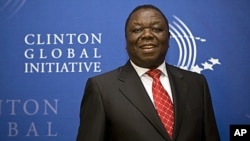



Morgan Tsvangirai, the prime minister in Zimbabwe's inclusive government, said Wednesday that what he called the "warped" policy of "indigenization" is frightening off potential investors. President Robert Mugabe’s ZANU-PF party is trying to insist that all companies, both privately-owned and those listed on the stock exchange, are at least 51 percent owned by black Zimbabweans.
Mr. Tsvangirai, who heads the Movement for Democratic Change (MDC) party, briefed journalists in Harare Wednesday after his recent trip to the United States.
He said the indigenization policy causes him a headache and frightens off investors.
"Throughout these meetings the flawed nature of indigenization policy and our toxic politics proved to be major issues affecting investor confidence," he said.
The indigenization policy is meant to make up for the years of rule by Britain and later by a white minority government when there were economic restrictions placed upon black Zimbabweans.
While in New York, Mr. Tsvangirai briefed U.N. Secretary-General Ban Ki-moon on Zimbabwe’s progress, within the unity government, towards free and fair elections.
Mr. Tsvangirai said, in addition to the indigenization policy, investors and other leaders he met were concerned about continued political violence and uncertainty about the next elections in Zimbabwe.
"It is possible to rebuild this economy," he said. "There is a lot of good will out there to do business with Zimbabwe, as long we have political systems and predictability and as long as we come out with investor-friendly model, that balances the interest of the investment and the need to empower the ordinary person and not a few well-connected elite."
Mr. Tsvangirai said he supported an indigenization policy that uplifts the poor and contributes to building the economy.
He said the progress of political reforms within the inclusive government is not satisfactory, although he said there has been progress in rebuilding the social sector and the economy.
"Our biggest handicap is that if we don’t graduate from the current stagnation, because of discord on government policy, we are likely to see [continued] stagnation which does not lead to growth in jobs, growth in the economy and hence the crisis around the liquidity," he said.
Zimbabwe’s three-year-old multi-party political agreement calls for finalizing a new constitution and other political reforms ahead of new elections, which many analysts say are not possible until 2013.
Zimbabwe's PM Has 'Headache' Over Indigenization