


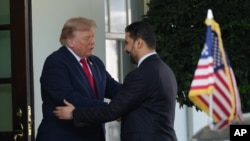
The completion of Iraqi Prime Minister Ali al-Zaidi's Cabinet has renewed concerns about the continued influence of Iran-backed Shiite groups in Baghdad, particularly following the appointment of a senior militia leader and U.S.-designated terrorist as deputy prime minister. But some political observers say the appointments could offer al-Zaidi an opportunity to consolidate his authority and gradually bring armed factions under government control.
The debate reflects competing assessments of whether accommodating Iran-aligned political forces will further entrench their influence in Iraq's government or provide al-Zaidi with the political leverage needed to reduce their power.
Iraq's parliament on Thursday approved more than a dozen Cabinet appointments, completing the formation of al-Zaidi's government five months after it took office. Several key positions had remained vacant amid political disputes and concerns about Iranian influence.
Lawmakers approved Nayef al-Shammari as defense minister and Yasir al-Maliki as interior minister. They also appointed Laith al-Khazali, a senior leader of the Iran-backed Shiite militia Asaib Ahl al-Haq, as a deputy prime minister.
Ties to Iran-backed terror group
The United States designated Asaib Ahl al-Haq a foreign terrorist organization in 2020 and named al-Khazali and his brother, Qais, as specially designated global terrorists. Washington has accused the group of carrying out attacks against American and coalition forces.
The appointment has raised concerns, though, that Iran-backed armed groups continue to wield considerable influence over Iraq's political institutions, despite efforts to strengthen the authority of the central government.
Republican Rep. Joe Wilson condemned al-Khazali's appointment on social media platform X, describing him as a “designated terrorist and Iranian puppet” and calling for an end to Tehran's influence in Iraq.
“He is no better than ISIS, maybe even worse,” Wilson said of al-Khazali, using an acronym for the Islamic State terror group. “It is outrageous but sadly not shocking that he has been appointed deputy PM of Iraq.”
[[ https://x.com/RepJoeWilson/status/2110800674560823428?s=20 ]]
Despite those concerns, the United States has reaffirmed its support for Iraqi Prime Minister al-Zaidi, emphasizing the importance of Iraqi sovereignty and curbing the influence of Iran-backed armed groups.
“As President Trump made clear when he hosted Prime Minister Al-Zaidi’s historic July 14 visit, the United States strongly supports his vision to ensure a brighter future for all Iraqis,” a State Department spokesperson told VOA in a statement.
The spokesperson said Washington's goal remains a sovereign and secure Iraq capable of preventing attacks from its territory and maintaining strong relations with the U.S.
“Iran is an untrustworthy actor with a long history of using Iraqi militias to steal resources from the Iraqi people and threaten Iraq’s sovereignty,” the spokesperson said, emphasizing that U.S. efforts to promote regional stability focus on strengthening national sovereignty and economic prosperity.
Pragmatic approach to Iran-backed groups?
Former U.S. diplomat Joey Hood says the Trump administration may be willing to give al-Zaidi greater flexibility in dealing with Iran-backed militias, rather than opposing political arrangements that bring some of their leaders into government.
Hood told VOA that Trump and his special envoy to Iraq, Tom Barrack, appeared to favor an approach centered on economic partnerships rather than military operations or direct intervention in Baghdad's political decisions.
“They do not appear to be interested in micromanaging how the prime minister gains primacy over the Iranian-backed militias, unlike some previous U.S. administrations,” Hood told VOA.
He said Washington could adopt a wait-and-see approach, allowing al-Zaidi to use figures such as al-Khazali to bring less cooperative armed factions under control.
“If al-Zaidi succeeds in using al-Khazali and others to squeeze the uncooperative groups, he will have found an Iraqi solution to this problem,” the former U.S. diplomat said.
Hood said such an approach would place greater responsibility on al-Zaidi to demonstrate that political accommodation can translate into stronger government authority over armed groups, rather than allowing those groups to consolidate their influence from within the state.
The former ambassador to Tunisia cautioned that the ultimate test of al-Zaidi's strategy would be whether Iran-backed groups could continue exploiting Iraqis, influencing political decisions and launching attacks against Iraqi citizens and neighboring countries.
Political compromises raise spending concerns
Following the parliamentary vote to approve his cabinet, al-Zaidi pledged swift action to implement his government's priorities, promising continued efforts to deliver on commitments to the Iraqi people.
Beyond the question of Iranian influence, the cabinet expansion has also prompted criticism that the new Iraqi prime minister is creating government positions to accommodate competing political forces at the expense of Iraq's public finances.
Before Thursday's parliamentary session, a number of lawmakers protested and boycotted the proceedings, opposing the creation of several deputy prime ministerial positions and new ministries.
The lawmakers argued that the additional posts reflected the distribution of government positions according to political party quotas, at a time when Iraq should instead be reducing public spending.
Ghalib Aldaamy, a Baghdad-based academic and political researcher, told VOA that many Iraqis opposed the creation of new ministries and senior government positions.
Instead, he said, there had been expectations that the government would merge some ministries and abolish other institutions to streamline government bureaucracy and reduce pressure on the national budget.