


Editor's note: this story was translated from the original VOA Dari article.
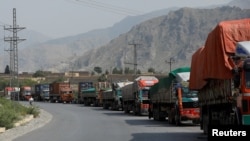
Trade between Afghanistan and Pakistan has declined sharply amid rising tensions between the neighboring countries and the continued closure of border crossings.
Mohammad Younus Mohmand, Vice President of the Afghan Chapter of the Pakistan-Afghanistan Joint Chamber of Commerce and Industry, said that the bilateral trade has fallen by about 95 percent.
“We no longer have trade with Pakistan. Our transit via Pakistan and Pakistan’s transit via Afghanistan to Central Asia have come to a complete halt,” Mohmand said.
Pakistani newspaper Dawn reported Monday that the figures released by the Trade Development Authority of Pakistan in August showed that bilateral trade between the two neighboring countries fell 95 percent in 2026-27 compared with the previous year.
The TDAP also reported that bilateral trade fell to $358 million in fiscal year 2025-26, down from $1.3 billion in fiscal year 2024-25, a decrease of about 74 percent.
Pakistan closed the main border crossings with Afghanistan on Oct. 12, 2025, after deadly clashes between the Pakistani forces and the Afghan Taliban.
In September, Pakistani government said that it was ready to reopen the border crossings if the Taliban took measures against the militant groups operating from Afghanistan.
Relations between Pakistan and the Taliban deteriorated as Pakistani authorities accused the Taliban of harboring the militant group, Tehrik-e-Taliban Pakistan, or TTP, which has taken responsibility for attacks inside Pakistan.
The Taliban publicly deny harboring any militant group, but a U.N. report, released in August, said that the Taliban continue to support TTP.
The closure of the border crossings has hurt Pakistani industries, particularly pharmaceuticals, according to government data.
Pakistan's Dawn newspaper, citing Pakistan's Bureau of Statistics, said pharmaceutical exports declined 25.53 percent in the first quarter of 2026-27, which is primarily attributed to the disruption of trade with Afghanistan.
Mohmand said that the Taliban’s government was seeking alternative trade routes, but “Pakistani traders are at a loss.”
“I think the Pakistani traders have lost and continue to lose the 40-million-people market of Afghanistan,” he added.
Azarakhsh Hafizi, an economist and former head of the international relations committee at Afghanistan's Chamber of Commerce and Industries, told VOA that the halt in bilateral trade is “not in the interest of” either Afghanistan or Pakistan.
“Pakistani industries not only reach Afghan markets but also export via Afghanistan to Central Asia,” he added.
Hafizi said that Afghanistan’s exports via Pakistan were valued at around $1 billion and Pakistan was one of the largest destinations for Afghan products in 2024, with exports totaling $659 million.
Momand said that he “hopes the tensions between the two neighboring countries end soon.”