


Editor's note: this story was translated from the original VOA Dari article.
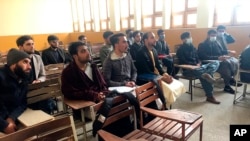
University enrollment among men in Afghanistan in 2026 has fallen nearly one-third from levels before the Taliban’s takeover, while women’s enrollment has remained at zero for the third consecutive year.
A new U.N. report says enrollment at public and private universities in Afghanistan totaled approximately 208,000 students, all men, in 2026, down from about 430,000 students, including 124,000 women, in 2020.
“Women remain excluded from formal participation, male enrollment is substantially lower than in 2019, the academic workforce has shrunk, and private institutions face continuing financial pressure,” the report said.
The Taliban barred women from university education in December 2022 and from medical training institutes, which offer diplomas in nursing, midwifery and other health fields December 2024.
Since seizing power in 2021, the Taliban have placed sweeping restrictions on women’s rights and freedom.
Under the Taliban, women and girls are not allowed to get an education beyond 6th grade. They are barred from working with government and non-government organizations, going to parks, gyms, public baths, and beauty salons.
The group has issued more than 100 decrees that curb women’s and girls’ rights and freedoms, including their right to get an education.
No Motivations for Education
Meanwhile, the Taliban have tightened their control over men’s higher education by imposing numerous restrictions, such as conducting new oral exams on religious topics, dress codes, removing hundreds of books and other learning materials, and discontinuing over a dozen subjects related to human rights, democracy, gender, governance and other social science fields, according to the U.N.
Farid, a university student in Kabul, told VOA that students have few incentives to pursue higher education.
“There are only a few opportunities for graduates. This makes people not be motivated to continue their studies,” said Farid, who did not want his full name disclosed for security reasons.
He added that most of the students also face financial problems, forcing them to discontinue their studies.
“The economic situation has worsened. Students are not even able to pay for commuting to the university daily,” he said.
Farid added that students are also worried about their job prospects after graduation.
Mohammad Asif Nang, former deputy minister for education in Afghanistan, told VOA that the future of higher education in Afghanistan is uncertain.
“For example, a young man loses hope of a better future when he cannot find himself in a system based on competition, merit and professional qualifications,” he said.
“These trends affect not only higher education itself but also the future supply of qualified professionals across Afghanistan’s education, health and wider service sector,” the U.N. report said.