


Editor's note: This story was translated from the original VOA Mandarin article.
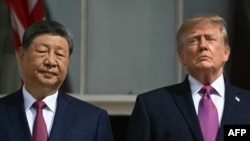
On Wednesday, the White House told the Voice of America (VOA) that President Donald Trump’s foreign policy decisions “have never been motivated by politics.” The U.S. president is going to meet with Chinese President Xi Jinping in two weeks on the sidelines of the APEC summit in Shenzhen, China — their third bilateral meeting this year.
Voters focused more on affordability and the war with Iran in midterm elections that brought Democratic victories. President Trump will deal with a new Congress in January led by Democrats.
Recently, Democrats have criticized the White House for its delay of a $14 billion arms sale to Taiwan, loosening restrictions on advanced chip sales to China, and the administration's refusal to confront Beijing over its continued support of Iran.
Will the changing political landscape on Capitol Hill add new dynamics to the interactions between the two leaders?
In an email responding to a request for comment from VOA on Wednesday, White House Deputy Press Secretary Anna Kelly stated: “President Trump’s foreign policy decisions have never been motivated by politics. The Commander-in-Chief will always act in the best interest of the American people and our national security.”
Bipartisan consensus
In an analysis piece published following the midterm elections, Credendo — a Brussels-based European credit insurance group specializing in trade credit and political risk insurance — observed that there is little disagreement between the two major U.S. parties regarding relations with China.
The article points out that both parties view Beijing as a potential adversary and threat, therefore both support a restrictive approach, including export controls on advanced technology and restrictions on Chinese investments into the U.S., while avoiding an escalation in trade tensions.
The article further notes that an overwhelming majority on both sides in Congress supports strengthening U.S.-Taiwan relations.
David Shedd, former acting director of the U.S. Defense Intelligence Agency, believes that a shared concern by both parties regarding the threat posed by China serves as a foundation for policy continuity.
“While there's never unanimous positions on every single issue about China, there certainly is a very strong bipartisan trend within the House as well as the Senate when it comes to the threats represented by China,” he said in a pre-election interview with VOA.
Shedd predicts that the president will continue to seek constructive engagement with China, while Congress will keep scrutinizing security threats.
On Wednesday, China Foreign Ministry Spokesperson Mao Ning said that Beijing is ready to continue working with Washington. In response to a question at the regular press briefing, she described the U.S. midterm elections as “a domestic affair” and stated that “China stands ready to continue working with the U.S. to uphold and deliver on the important common understandings reached by the two heads of state.”
Room for maneuvering
Experts are assessing how the midterm election results could affect the Trump administration’s ability to deal with China.
Alicia Garcia-Herrero, chief economist for the Asia-Pacific region at the French investment bank Natixis, told Reuters, that the newly empowered Democrats could try to limit Trump's maneuvering power. "Democrats are unlikely to give Trump free rein on deals with Beijing," she said.
However, Jon Czin, a fellow at the Brookings Institution and former director for China affairs at the White House National Security Council, says when it comes to Washington’s China policy directions, while Congress may exert greater pressure and advance relevant bills, it is the president who remains in the driver’s seat.
"I don't think there will be big fluctuations in U.S.-China policy." said Czin in a pre-election interview with VOA.
Secretary of State Marco Rubio said that he learned as a former U.S. senator that a new Congress cannot change foreign policies that the president was elected to carry out.
“To my great frustration, when I was a member of the Senate, I realized that while there are things we could do, ultimately the foreign policy decisions are made by the Executive Branch,” Rubio said last Friday. “Congress plays a role. There’s no doubt about it. But the central role belongs to the Executive Branch.”
After Tuesday’s midterm elections, President Trump has emphasized "one of the stronger powers that a President has" — veto power.
VOA Mandarin’s Yu-wen Cheng and Lin Feng contributed to this report.