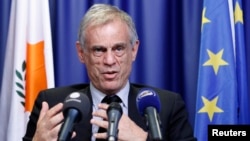
Cyprus' Finance Minister Michalis Sarris holds a news conference at the end of a Eurogroup meeting at the European Council building in Brussels, March 25, 2013.
Stock markets rallied and politicians praised a European Union and International Monetary Fund bailout agreement for Cyprus reached early Monday after marathon talks in Brussels. But analysts predict difficulties ahead for the country as it tries to get onto a more sustainable economic footing.
The $13 billion bailout agreement for Cyprus ends days of financial upheaval and speculation that the tiny island nation might pull out of the 17-member euro currency union.
Speaking to reporters after the talks ended in Brussels, Cypriot Finance Minister Michalis Sarris hailed the deal.
"A long period of uncertainty and insecurity surrounding the Cyprus economy has ended. I believe we have averted literally the possibility of bankruptcy and we have assured the prospects for generations to come," Sarris said.
Also attending the meeting was International Monetary Fund chief Christine Lagarde, who said the talks had yielded a "good result." Lagarde said she would recommend the IMF contribute to the bailout package.
"We believe this will form a lasting, durable and fully financed solution," she said.
The deal radically cuts Cyprus's oversized banking sector, and forces losses on depositors holding more than 100,000 euros (about $130,000) in savings. It also calls on the government to cut spending and carry out economic reforms, including privatizing state assets.
In the short term, economist Tomasz Michalski, of the HEC business school in Paris, predicts Cyprus will likely sink further into recession as it struggles to meet the bailout terms and turn around its economy.
"A lot of people are going to become unemployed. Probably, they're going to have to raise taxes, because there was a very low tax environment," he predicted. "They're going to have to cut government spending a lot, retirement pensions."
Michalski says big foreign depositors in Cypriot banks, including Russians and Britons, will also take a big hit.
"There's a shockwave [going] through all this world of nice, offshore, tax-free havens. If something is going to happen through a tax-free haven, that's the risk you place to hold your money," he warned. "From the perspective of all the high-tax governments in the eurozone, like France, Belgium and Germany, where we know there is a lot of tax avoidance and tax evasion, this is very good news."
The bailout deal ensures that the European Central Bank will continue providing funding to Cypriot banks. But Brussels-based European Policy Center analyst Janis Emmanouilidis says it also means Cyprus must now find another growth strategy.
Eurozone Bailouts
Countries that received Eurozone bailouts:
Spain, 2012: $129 billion
Portugal, 2011: $100 billion
Ireland, 2010: Ireland: $110 billion
Greece, 2010 & 2012: $316 billion
"What the Cypriots have and what their hopes are is that what they're losing in one sector - in the banking sector - they'll be able to cover in the energy sector," noted Emmanouilidis. " Because of the energy [oil] being found off the coast of Cyprus. But that will take a while. It will take a couple of years before these things can be exploited fully."
With the agreement, Cyprus now joins Greece, Ireland and Portugal, who have also received bailouts since the eurozone crisis began in 2009.
The Eurozone's 5 Bailouts
1/9In late 2009, Greece's government admitted that public debt was far higher than official statistics showed. That led it to accept a bailout package of 110 billion euros in May 2010. When the economy kept weakening, a second bailout was confirmed in February 2012 for another 130 billion euros.
Cyprus' bailout deal is the fifth agreed on so far in the group of 17 European Union countries that use the Euro, since the debt crisis began in late 2009.
Show moreShow less
2/9Ireland's banks suffered from their exposure to the U.S. mortgage market meltdown as well as to a collapse in the local housing sector. The government stepped in to guarantee creditors and deposits, but as it rescued its banks, the costs grew.
Cyprus' bailout deal is the fifth agreed on so far in the group of 17 European Union countries that use the Euro, since the debt crisis began in late 2009.
Show moreShow less
3/9Soon Ireland's borrowing rates on bond markets rose so high it was unable to finance itself independently. It secured a 67.5 billion euro package in November 2010.
Cyprus' bailout deal is the fifth agreed on so far in the group of 17 European Union countries that use the Euro, since the debt crisis began in late 2009.
Show moreShow less
4/9After Ireland's rescue, investors focused on Portugal, the next weakest country in the currency bloc. Their economy was weak and public finances shaky. The government's borrowing rates in bond markets kept rising on fears it finances would become unsustainable.
Cyprus' bailout deal is the fifth agreed on so far in the group of 17 European Union countries that use the Euro, since the debt crisis began in late 2009.
Show moreShow less
5/9By April 2011, talks on a bailout for Portugal began. In May 2011, the country agreed to a package of 78 billion euros in rescue loans.
Cyprus' bailout deal is the fifth agreed on so far in the group of 17 European Union countries that use the Euro, since the debt crisis began in late 2009.
Show moreShow less
6/9Spain's weak economy worried European investors because it is much larger than those of Greece, Ireland or Portugal. Giving it rescue loans would test the eurozone's financial capabilities. The Spanish government and eurozone officials agreed on a deal in July 2012 to get up to 100 billion euros in rescue loans directly for the banks.
Cyprus' bailout deal is the fifth agreed on so far in the group of 17 European Union countries that use the Euro, since the debt crisis began in late 2009.
Show moreShow less
7/9For a few weeks it seemed the Spanish government would also need rescue loans, but its borrowing rates in bond markets fell after the European Central Bank vowed to do "whatever it takes" to save the euro.
Cyprus' bailout deal is the fifth agreed on so far in the group of 17 European Union countries that use the Euro, since the debt crisis began in late 2009.
Show moreShow less
8/9The European Central Bank's move calmed markets in Europe for months, but Cyprus's financial problems grew. The country's banks had taken losses from Greece's debt writedown, and the government was overwhelmed by the cost of supporting its banks.
Cyprus' bailout deal is the fifth agreed on so far in the group of 17 European Union countries that use the Euro, since the debt crisis began in late 2009.
Show moreShow less
9/9Cyprus first asked for a eurozone and IMF rescue package in June 2012. The talks continued for months and in March 2013, a new deal was finally crafted to raise the money they needed to qualify for the rescue loans.
Cyprus' bailout deal is the fifth agreed on so far in the group of 17 European Union countries that use the Euro, since the debt crisis began in late 2009.