


Editor's note: This story was adapted from the original Kurdish video story.
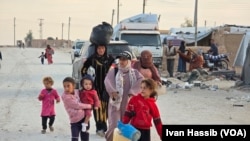
After more than seven years of displacement, Daham Ibrahim is finally preparing to return home in the countryside of Sere Kaniye (Ras al-Ayn) in northeast Syria.
Ibrahim, who had hoped that his tent would become nothing more than a painful memory of the past, is now taking it with him to set it up on the site where his house once stood.
“I’m returning to my village, but I have no choice but to set up this tent at the same place where my house used to be,” Ibrahim, a father of eight, told VOA. “My house was destroyed during the war. Our village used to have 500 houses; now barely 100 houses are intact.”
Ibrahim is one of many who were displaced during a 2019 Turkish-led offensive against the Kurdish-led Syrian Democratic Forces (SDF), a former U.S. partner in the fight against the Islamic State terror group.
Since last August, thousands of displaced people in northeast Syria have been returning home as part of an integration process between the interim Syrian government and the SDF.
According to Syrian government officials, more than 4,000 families have returned to the Sere Kaniye region. But, like Ibrahim, most returnees are going back to destroyed or damaged houses.
To help compensate for these losses, the Syrian government is providing each returning family with $2,000 in assistance. But many say the amount isn't enough to rebuild their homes.
At displacement camps, those still waiting to return home hope that authorities will expedite the process, especially as a harsh winter approaches.
“We have endured seven years of hunger and cold. It is time for us to go back home,” said Fatima Habash, another displaced person from Sere Kaniye.
“We yearn for a normal life. The government needs to remove those people who are living in our houses, so that we can return to them,” she told VOA.
Before the fall of the Bashar al-Assad regime in December 2024, Sere Kaniye was under the control of Turkish-backed Syrian armed groups. Although those groups have since integrated into the Syrian ministry of defense, their continued presence, along with that of their families living in houses of displaced residents, has made it difficult for many to return.
Mahmoud Khalil, deputy commander of the Internal Security Forces in Hasaka province, said efforts are underway to remove families currently occupying the homes of Sere Kaniye residents.
“If everything goes according to plan, we should be able to facilitate the return of 1,000 people to the city within a month,” Khalil told VOA.
The Sere Kaniye Displaced Persons Committee, a civil society group advocating for displaced people in northeast Syria, this week said that returning home is a fundamental right for displaced people, particularly now that in its view, the Syrian conflict has ended.
The group called on Syrian authorities to ensure the safe and voluntary return of people still living in displacement camps.