



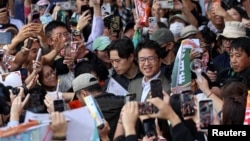
Editor's note: this story was translated from the original VOA Mandarin article.
When Taipei voters choose a mayor Saturday, they will decide who oversees housing and transportation in Taiwan’s capital. They will also choose who represents Taipei at an annual forum with Shanghai, one of the few places where senior officials from Taiwan and China still meet. One candidate, Puma Shen, is wanted by Chinese police on allegations of separatism.
The Taipei race illustrates why Beijing is watching elections fought largely over local concerns. Across Taiwan’s 22 cities and counties, the results could shape whom Beijing deals with and which parties enter Taiwan’s 2028 presidential campaign with the strongest local networks.
What are voters deciding?
Nearly 19.6 million people are eligible to vote for mayors and county magistrates, according to Taiwan’s Central Election Commission. The “nine-in-one” elections cover nine categories of local office and will fill 11,051 posts, down to village and neighborhood chiefs. A separate national referendum asks whether Taiwan should use nuclear power to boost its economy and abandon its goal of a nuclear-free homeland.
Transportation, housing, and public services have featured prominently in the campaigns. The central government sets defense policy and manages relations with Beijing. Saturday’s vote leaves intact the legislative majority held jointly by the opposition Kuomintang, or KMT, and the smaller Taiwan People’s Party, or TPP.
William Brent Christensen, a former director of the American Institute in Taiwan, told VOA in Washington on November 17 that the campaigns had focused largely on domestic issues. He expected some impact on U.S. engagement with Taiwan, though he saw no specific implication for those ties.
“The United States “certainly interacts with both major parties,” Christensen said. “We believe that Taiwan is fully capable of conducting free and fair elections, and we look forward to seeing how things turn out this year.”
Why does the Taipei race matter to Beijing?
China considers Taiwan part of its territory and has refused to talk with President Lai Ching-te, whom it labels a separatist. Lai rejects Beijing’s claim, saying only the Taiwanese people can decide the island’s future. Beijing does keep channels open with the KMT, which supports closer ties with China.
In Taipei, KMT Mayor Chiang Wan-an faces Shen, a lawmaker from Lai’s Democratic Progressive Party, or DPP, who has studied Chinese disinformation. Shen told Reuters he would be willing to continue the Taipei-Shanghai forum if Beijing imposed no political conditions and refrained from harassment. Chiang’s campaign has also said outside powers should refrain from pressuring Taiwanese voters. A Shen victory would raise a question for Beijing: Would Shanghai officials sit down with a mayor whom Chinese police are pursuing?
What could the results mean for 2028?
Two cities offer a test of each major party’s ability to win on the other’s turf. New Taipei, which surrounds the capital, has more than 3.4 million eligible mayoral voters, the largest electorate in Taiwan. The DPP’s Su Chiao-hui faces the KMT’s Lee Shu-chuan for an office the KMT holds. In the southern port of Kaohsiung, the KMT is trying to capture a DPP stronghold with more than 2.3 million eligible voters.
For Lai, who is eligible to seek a second term, gains in KMT-held cities could strengthen his standing within the DPP, according to analysts Emma Y. Liu and Edgard D. Kagan of the Center for Strategic and International Studies. The KMT has yet to choose a presidential candidate. Outgoing Taichung Mayor Lu Shiow-yen is considered a leading contender. Lai himself served as mayor of Tainan before becoming president.
Saturday also offers an early test of opposition cooperation. The TPP backs Chiang in Taipei while fielding its own candidates elsewhere. Its ability to win offices under its own name could affect its bargaining power in any talks with the KMT about a joint campaign in 2028.
Recent elections show how differently Taiwanese voters can judge candidates for mayor and president. In 2018, the KMT won 15 of Taiwan’s 22 city and county leadership posts. Two years later, voters reelected DPP President Tsai Ing-wen. In 2022, the KMT won 14 of those posts. In 2024, voters chose Lai.