



Editor's note: this story was translated from the original VOA Kurdish article.
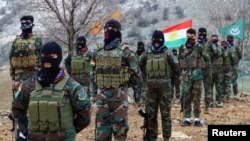
Iranian Kurdish opposition leaders based in Iraq’s Kurdistan Region have ruled out turning themselves in to Tehran as part of potential amnesty deal, citing lack of trust in Iran to guarantee their safety.
Their comments come after Iraqi officials reported progress in negotiations involving Baghdad, the Kurdistan Regional Government (KRG) and Iran over the future of Iranian Kurdish opposition groups that have a maintained presence in northern Iraq for decades.
Iraq's Foreign Minister Fuad Hussein confirmed last week that one of the options discussed during the trilateral talks included potential amnesty for the Iranian Kurdish armed group members who wished to return, if they felt safe.
Amanj Zibaee, a member of the central committee of the Kurdistan Democratic Party of Iran (KDPI), an armed opposition group seeking greater autonomy for Kurds in Iran, and the party’s representative in Erbil, told VOA that his group categorically rejects the prospect of surrendering to Iranian authorities.
“The Islamic Republic of Iran makes many promises but offers nothing in practice. Surrendering to it is something we completely reject, and it is not even an option we have discussed,” he said.
Zibaee said his party would wait for an official announcement over the proposal discussed between Baghdad, Tehran and Erbil before determining its response.
“Once the Iraqi government and the Kurdistan Regional Government officially announce their positions, the KDPI leader will make an appropriate decision,” he said.
He said his organization has acted responsibly and has not used Iraqi territory to attack Iran, a key demand by Baghdad.
“We have never used the Kurdistan Region of Iraq as a base to launch attacks against a neighboring country. We have acted responsibly, and we will continue to do so,” Zibaee said.
Khalil Nadri, spokesperson for the Kurdistan Freedom Party, also dismissed the possibility of accepting an Iranian amnesty.
“We have an agreement with the Kurdistan Region that we will not conduct military operations against Iran from its territory. Our struggle against Iran takes place inside Iran, in Eastern Kurdistan,” Nadri told VOA, referring to predominantly Kurdish areas of western Iran.
He said his party had respected Iraqi sovereignty and helped defend the region against the Islamic State and Iran-backed armed groups, including the Popular Mobilization Forces.
“Iran is not in a position to grant us amnesty,” Nadri said. “Our homeland has been occupied. We will return when our homeland is liberated and the enemy has withdrawn.”
Iranian attacks
Iran has repeatedly over many years launched missile, and drone strikes targeting Iranian Kurdish opposition groups based in northern Iraq that have been fighting for Kurdish regional autonomy or independence in Iran. The attacks surged following the outbreak of the conflict in the Middle East as Iran launched retaliatory attacks against neighboring countries.
The Iranian Kurdish armed opposition Komala party said Monday that two missiles struck the entrance to one of its bases in the Balisan Valley in Iraq's Kurdistan Region.
Idris Kolahdozi, a member of the party's Central Committee and its head of relations in Sulaimaniyah, told VOA that the attack caused no casualties or property damage.
There was no immediate independent confirmation of who carried out the attack.
Baghdad reports progress in negotiations
Iraqi Foreign Minister Hussein said the latest round of negotiations between Iraq, Iran and the Kurdistan Regional Government that started in October in Baghdad are continuing and that several options were under consideration.
In an interview with France 24, Hussein said the parties had reached a degree of understanding about how to address the opposition groups’ presence in Iraq.
He raised a possible amnesty deal that could allow Iranian Kurdish opposition members to return to Iran, provided they received credible guarantees for their personal safety.
Earlier this month, Iraqi government spokesperson Haider Aboudi told VOA that discussions had reached an “advanced stage” and that Baghdad hoped to resolve the issue soon, though no final deal has been publicly disclosed.
Aboudi emphasized that Iraq was determined to prevent its territory from being used to attack neighboring countries.
KRG spokesperson Peshawa Hawramani similarly told VOA that the regional government would not allow its territory to be used to harm neighboring states.
The negotiations come amid continued Iranian pressure on Baghdad and Erbil to remove Iranian Kurdish opposition groups from Iraqi territory. Tehran has repeatedly accused the groups of threatening its security, allegations the opposition parties deny.
Last month, KDPI spokesperson Khalid Azizi told VOA that his party had largely complied with Iraqi requests to withdraw from areas near the Iranian border.
He said the party had engaged in discussions with Iraqi and Kurdish authorities, with United Nations involvement, over the region's security for several years.