


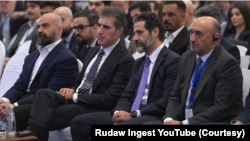
Editor's note: this story was translated from the original VOA Kurdish article.
Senior leaders in Iraq's Kurdistan Region have publicly discussed efforts to facilitate peace talks between Iran and Iranian Kurdish armed opposition groups based in the autonomous region.
Bafel Talabani, the head of the Patriotic Union of Kurdistan (PUK), said on Monday that a process similar to peace efforts between Turkey and Kurdish militants had begun with Iran.
"We are at the beginning of a similar process with our Iranian brothers and sisters," Talabani said at an event in Erbil, adding that the issue had been discussed extensively with Tehran, which had responded positively.
"Iran has offered to help us create a general peace process in the region," he said. "I think this dialogue will be very, very important."
The PUK, which holds Iraq's presidency, maintains close relations with Tehran.
Kurdistan Region President Nechirvan Barzani, however, offered a more cautious assessment, saying discussions had not yet reached the level of the peace process in Turkey, where the Kurdistan Workers' Party (PKK) has announced a decision to disarm last year.
"A process similar to Turkey's peace process in Iran may not have begun yet, but it is being considered," Barzani told the Middle East Research Institute (MERI) in Erbil on Monday.
Barzani said Kurdish leaders had repeatedly raised the issue with Iranian officials and stressed that Tehran and its Kurdish opposition should seek a peaceful settlement.
The comments mark a rare public acknowledgment of diplomatic efforts involving Iran and Kurdish opposition groups that have been exiled to the Iraqi Kurdistan for decades.
Security concerns and opposition response
Iraqi Kurdish leaders have long viewed tensions between Tehran and the Iranian Kurdish opposition as a threat to their region’s security and an obstacle to improving relations with Iran. They argue Iran often uses the presence of Iranian Kurdish opposition in their region as a pretext for missile and drone attacks.
Barzani criticized the Iranian Kurdish groups on Monday, accusing them of acting irresponsibly since the launch of the U.S. and Israeli military campaign against Iran on Feb. 28.
"The Kurdish opposition of Eastern Kurdistan [Iran], with deep regret, acted very irresponsibly," he said.
Iranian Kurdish opposition groups say they favor a peaceful settlement with Tehran but remain deeply distrustful of the Islamic Republic, citing decades of conflict and the assassinations of Kurdish leaders during previous diplomatic efforts.
Khalid Azizi, spokesperson for the Kurdistan Democratic Party of Iran (KDPI), told Rudaw on Monday that his party was open to negotiations but questioned Tehran's intentions and who could represent Iran following the reported deaths of senior officials in recent U.S. and Israeli strikes.
Iraq and Iran officials are scheduled to meet on Oct. 19 to discuss the opposition groups' presence in Iraqi Kurdistan, Iraqi National Security Advisor Qasim al-Aboudi told Rudaw on Tuesday.
Under a 2023 security agreement, Baghdad agreed to relocate Iranian Kurdish armed groups away from the border and prevent cross-border attacks while allowing them to remain in Iraq as refugees.
Tehran has repeatedly targeted the groups, accusing them of threatening its security, allegations they deny. Opposition representatives told VOA that more than 420 Iranian attacks since Feb. 28 had killed 23 people, figures that could not be independently verified.
Iran's Kurdish population is estimated at around 9 million, or roughly 10% of the country's population, although some estimates are as high as 15 million. Iran does not publish official ethnic population figures.
UNHCR estimates that 10,000 to 30,000 Iranian Kurdish refugees and asylum seekers live in Iraq, mostly in the Kurdistan Region.
Doubts over prospects for peace
Despite the public statements by Iraqi Kurdish leaders, some Iranian Kurdish political figures remain skeptical that negotiations would produce meaningful results.
Jalil Azadikhah, an Iranian Kurdish political analyst and activist based in Washington, told VOA that efforts to initiate a peace process had been underway for a long time but were only now being discussed publicly.
He argued that Tehran's objective was not to resolve the Kurdish issue but to weaken and ultimately dismantle the Kurdish opposition movement.
"At this point, I think any form of negotiation between the Kurdish parties and Iran is inappropriate, because there is no right opportunity for it now," Azadikhah said.