


Editor's note: this story was translated from the original VOA Korean article.
Once a symbol of economic cooperation between the two Koreas, the Kaesong Industrial Complex brought together South Korean companies and North Korean workers. It has remained a symbol of the breakdown in inter-Korean ties since operations were suspended in 2016.
The complex began operating in 2004, combining South Korean capital and technology with North Korean labor. It became a major hub of inter-Korean economic cooperation, with large numbers of workers and cargo trucks moving through the site. South Korean companies manufactured a range of products there, including underwear, tableware and electronics. Some of those goods entered overseas markets labeled “Made in Korea.” The complex became a prominent example of the two Koreas sharing economic interests.
But relations deteriorated as North Korea continued conducting nuclear tests and long-range missile tests. In February 2016, the South Korean government decided to suspend all operations at the complex. Production by South Korean companies came to a halt, leaving much of their equipment and other assets behind.
Signs of activity at complex
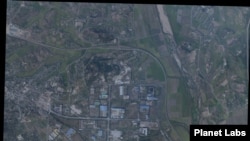
Last month, three South Korean soldiers were injured in a landmine explosion in the border area. The site of the incident was about 11.5 miles from Kaesong, where changes are now taking place under North Korean control, according to satellite images captured by U.S.-based data analytics and aerospace company Planet Labs.
Images taken of the complex on September 28 show buses at several factory sites formerly used by South Korean companies. VOA independently analyzed the Planet Labs satellite imagery and manually counted 11 buses parked or moving around the sites.
The buses were previously used to transport workers living in Kaesong and other parts of North Korea to and from the complex. South Korea’s Unification Ministry said the Kaesong Industrial District Management Committee operated about 290 buses for North Korean workers at the time of the complex’s closure in 2016.
Their presence at factory sites formerly used by South Korean companies suggests that North Korea is mobilizing workers to make use of the facilities and infrastructure left behind. VOA also has identified groups of people believed to be workers at factory sites in satellite images taken in recent years.
Cho Kyung-joo is chairman of the Seoul-based Kaesong Industrial Complex Business Association, which represents the South Korean companies that used to have factories at the complex before it was shut down. He told VOA that businesses are struggling amid difficult conditions in South Korea, and he hopes that improved U.S.-North Korea relations will help pave the way for reopening the complex.
“We hope the Kaesong Industrial Complex can reopen soon. Everyone is having a very hard time right now," he said. "Given the current situation in South Korea, discussions about reopening have not been going well. In any case, we very much hope President [Donald] Trump will make efforts to improve relations with North Korea so that the complex can reopen as soon as possible.”
Changes are also evident at the complex’s bus depot. Based on VOA’s regular monitoring and counting of buses in satellite images of the area over the past year, the number of buses visible in recent satellite imagery has fallen to fewer than 100, compared with nearly 300 in earlier imagery. Additionally, buses have been spotted in Kaesong city in previous satellite images, suggesting that many of those no longer seen at the depot may still be used to transport workers or for other purposes.
A new building has been observed inside the complex, on a site near the northern entrance. The site, formerly used by South Korean company Dongwon F&B, is now occupied by a building that appears to have been completed in 2024. Recent satellite imagery shows landscaping in front of the building and signs that the surrounding area has been tidied up.
New factories and other buildings are also appearing in North Korean territory just outside the complex, changing the landscape around the site.
South Korea’s Unification Ministry, which handles inter-Korean exchange and cooperation, told VOA in an email that the buildings appear to include hospitals, general service centers and local factories that North Korea is constructing in regions across the country. The ministry also said North Korean state media had reported plans to build local factories in Panmun District, as part of the third year of the country’s regional development program.
North Korea appears to be continuing construction and making use of facilities on its own, both inside and around the Kaesong Industrial Complex, where assets belonging to South Korean companies remain.
Other facilities that symbolized communication and ties between the two Koreas were subsequently severed or destroyed. In June 2020, North Korea blew up the inter-Korean liaison office in Kaesong following a warning from Kim Yo Jong, the sister of North Korean leader Kim Jong Un and a senior ruling party official. The destruction of the joint facility, which had served as a channel for communication between the two sides, became a defining symbol of deteriorating relations.
In a recent ruling, a South Korean court ordered North Korea to pay the South Korean government 44.6 billion won, or $32.5 million, in damages for the unilateral demolition.
With inter-Korean relations strained and the prospect of reopening the complex uncertain, South Korean businesses that once operated there are turning to Washington for hope.