Scientists: Climate change gave significant boost to Milton's destructive rain
A member of the Pasco County Sheriff's Office goes out to help residents trapped in their homes as waters rise after Hurricane Milton caused the Anclote River to flood, Oct. 11, 2024, in New Port Richey, Fla.
Human-caused climate change intensified deadly Hurricane Milton 's rainfall by 20% to 30% and strengthened its winds by about 10%, scientists said in a new flash study. The analysis comes just two weeks after Hurricane Helene devastated the southeastern United States, a storm also fueled by climate change.
World Weather Attribution researchers said Friday that without climate change, a hurricane like Milton would make landfall as a weaker Category 2, not considered a "major" storm, instead of a Category 3.
WWA's rapid studies aren't peer-reviewed but use peer-reviewed methods. The WWA compares a weather event with what might have been expected in a world that hasn't warmed about 1.3 degree Celsius since pre-industrial times.
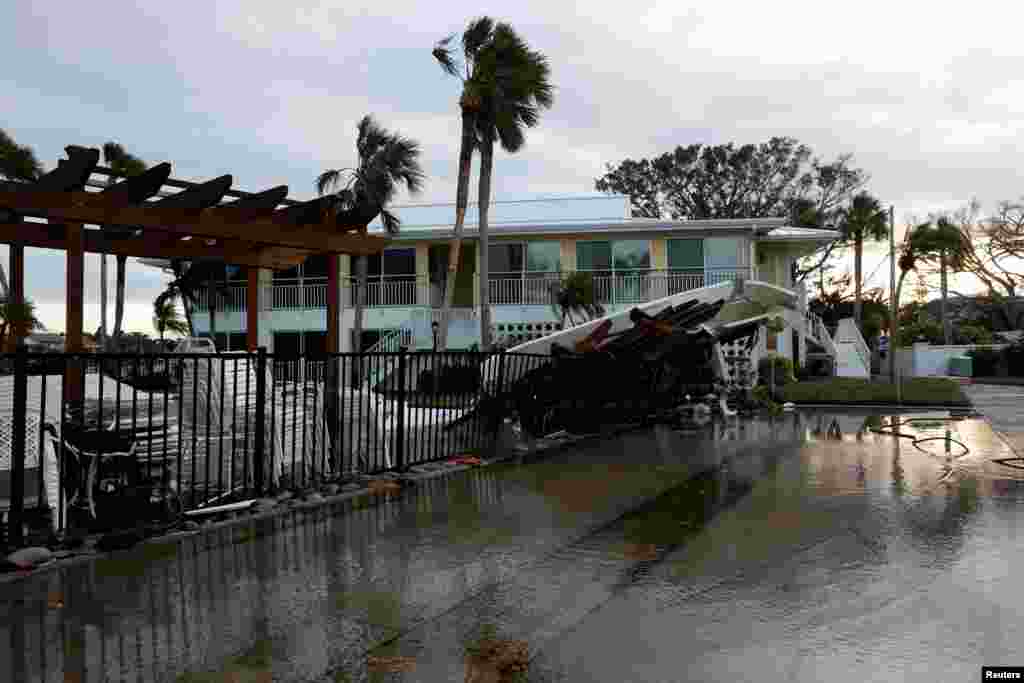
In photos: Hurricane Milton slams Florida
1/20Hangars at Albert Whitted Airport were damaged by winds from Hurricane Milton, in St. Petersburg, Florida, Oct. 10, 2024.
Show moreShow less
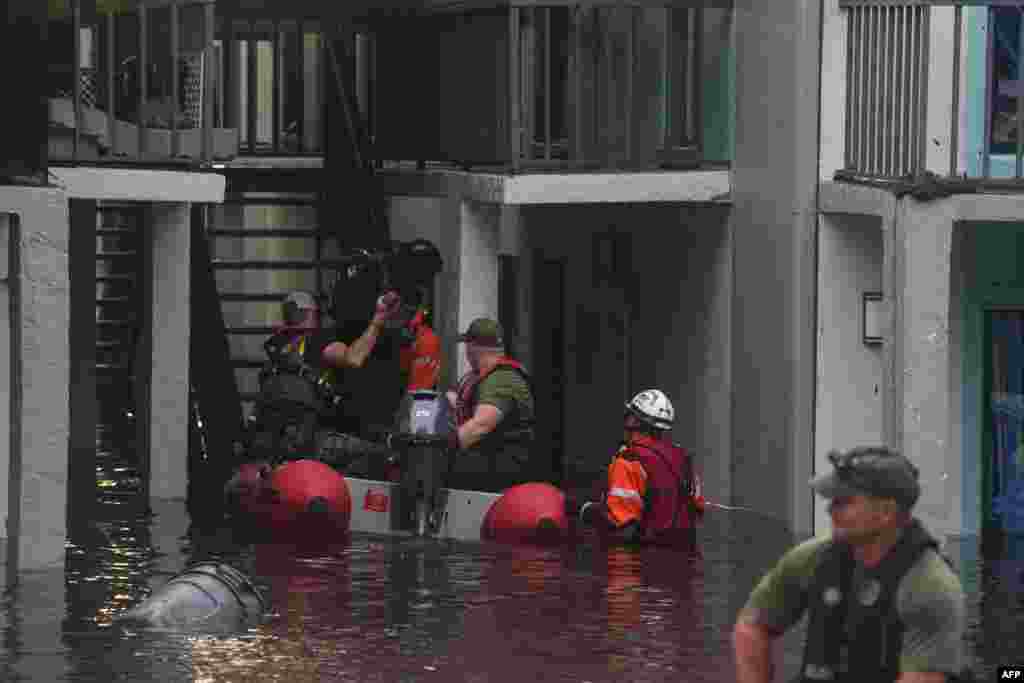
2/20People are rescued from an apartment complex in the aftermath of Hurricane Milton, in Clearwater, Florida, Oct. 10, 2024.
Show moreShow less
3/20A drone image shows the dome of Tropicana Field which has been torn open due to Hurricane Milton in St. Petersburg, Florida, Oct. 10, 2024.
Show moreShow less
4/20Marie Cook reacts to the damage to her home in the Binks Estates community after a tornado formed by Hurricane Milton touched down in Wellington, Florida, Oct. 9, 2024.
Show moreShow less
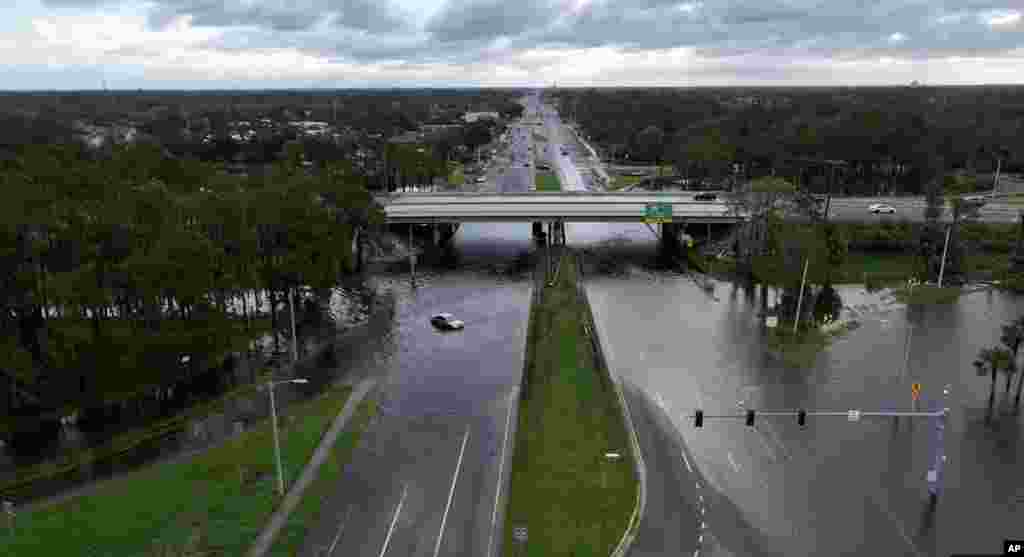
5/20This image provided by the Hillsborough County Sheriff's Office shows an aerial view of the extensive flooding on Hillsborough Avenue in Tampa, Oct. 10, 2024 after Hurricane Milton passed through the area.
Show moreShow less
6/20An intense tornado whipped up by Hurricane Milton destroyed a beauty salon in Cocoa Beach, Florida, on Oct. 10, 2024.
Show moreShow less
7/20Damage to a home is seen after a tornado ripped through The Preserve development in Wellington as Hurricane Milton tracked across Florida, Oct. 10, 2024.
Show moreShow less
8/20A billboard structure is seen after it was uprooted during Hurricane Milton, Oct. 10, 2024, in Clearwater, Florida.
Show moreShow less
9/20A view shows a collapsed construction crane that fell on the building that also hosts the offices of the Tampa Bay Times, after Hurricane Milton made landfall, in downtown St. Petersburg, Florida, Oct. 10, 2024.
Show moreShow less
10/20Residents are rescued from an their second story apartment complex in Clearwater that was flooded from and overflowing creek due to Hurricane Milton, Oct. 10, 2024 in Florida.
Show moreShow less
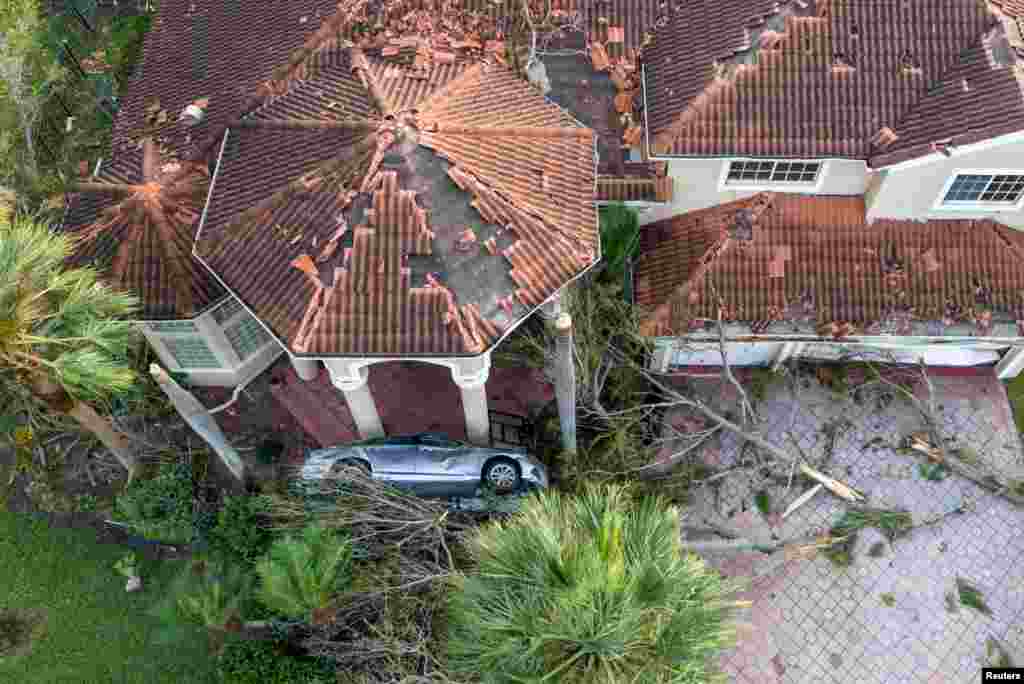
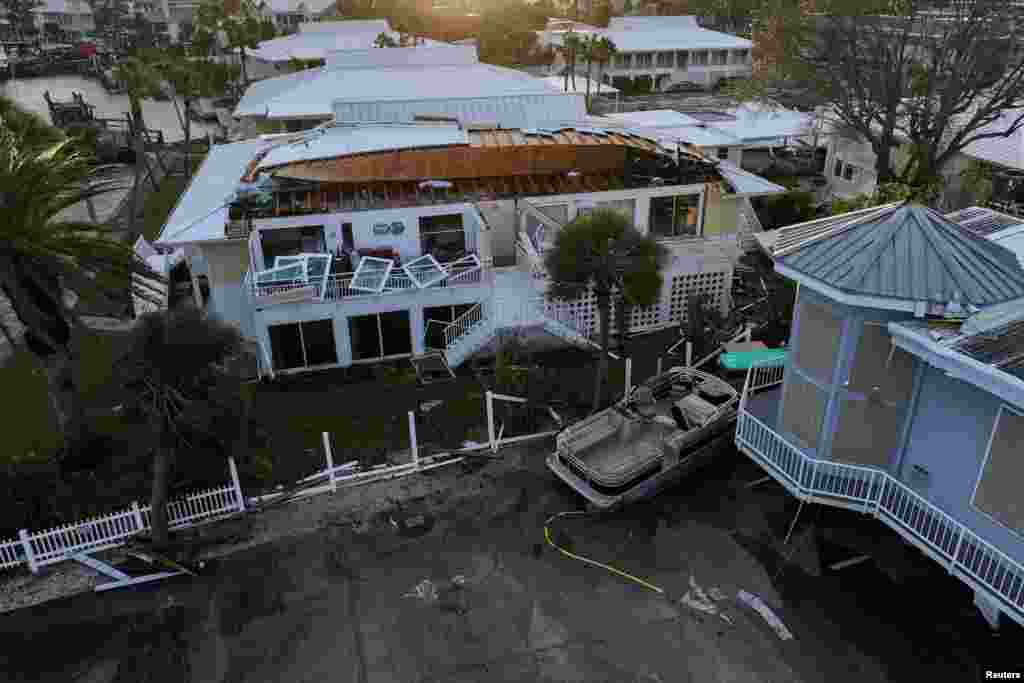
11/20A drone view shows buildings and other structures damaged by Hurricane Milton after it made landfall, in Venice, Florida, Oct. 10, 2024.
Show moreShow less
12/20Debris is strewn on a street following the collapse of a crane, during heavy rainfall and strong winds caused by Hurricane Milton, in St. Petersburg, Florida, Oct. 9, 2024, in this screengrab taken from social media. (Mike's Weather Page/via Reuters)
Show moreShow less
13/20Objects are submerged in water after Hurricane Milton made landfall, in Venice, Florida, Oct. 10, 2024.
Show moreShow less
14/20A view shows a fallen traffic light near a police car, after Hurricane Milton made landfall in Florida, in Orlando, Oct. 10, 2024.
Show moreShow less
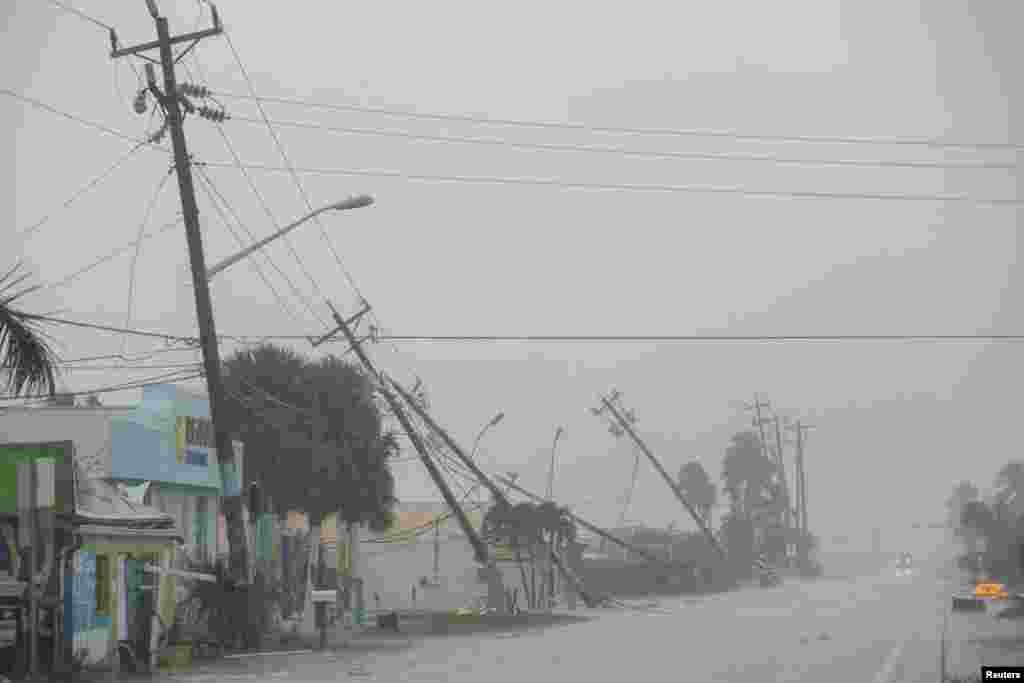
15/20Utility poles are seen downed by strong wind gusts as Hurricane Milton approaches Fort Myers, Florida, Oct. 9, 2024.
Show moreShow less
16/20Broken windows on a building are pictured as Hurricane Milton approaches Sarasota in Florida, Oct. 9, 2024.
Show moreShow less
17/20Water-flooded streets are seen after Hurricane Milton made landfall, in Fort Myers, Florida, Oct. 9, 2024.
Show moreShow less
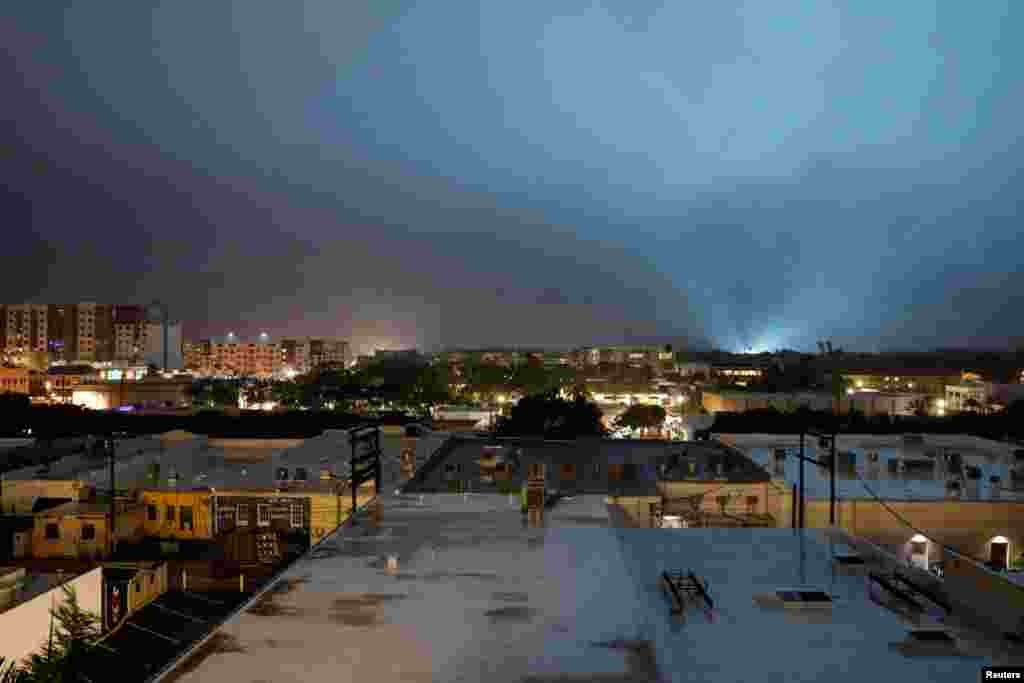
18/20The sky lights up as an electric installation is damaged as Hurricane Milton approaches Sarasota, Florida, Oct. 9, 2024
Show moreShow less
19/20A man records the storm as Hurricane Milton makes landfall, in Sarasota, Florida, Oct. 9, 2024.
Show moreShow less
20/20A Lee County Sheriff's officer patrols the streets of Cape Coral, Florida, as heavy rain falls ahead of Hurricane Milton, Oct. 9, 2024.
Show moreShow less
Previous slide
Next slide
The team of scientists test the influence of climate change on storms by analyzing weather data and climate models, but in the case of Milton — which followed so shortly after Helene — the researchers used only weather observations data. WWA said despite using different approaches, the results are compatible with studies of other hurricanes in the area that show a similar hurricane intensity increase of between 10% and 50% due to climate change, and about a doubling in likelihood.
"We are therefore confident that such changes in heavy rainfall are attributable to human-caused climate change," said WWA, an international scientist collaborative that launched in 2015 and conducts rapid climate attribution studies.
At least eight people died in Milton, which spread damage far and wide even though it didn't directly strike Tampa as feared. Roadways flooded and dozens of tornadoes tore through coastal areas. At one point power was out to some 3.4 million customers, and more than 2.4 million remained without power Friday morning.
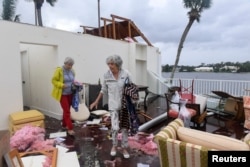
A Bayou West resident and friend try to salvage items from her home after an apparent tornado touched down on the central beach community after Hurricane Milton in Vero Beach, Fla., Oct.11, 2024. (Kaila Jones/USA Today Network via Reuters)
Milton made landfall Wednesday evening as a Category 3 hurricane on the west coast of Florida near Siesta Key, about 112 kilometers (70 miles) south of the Tampa Bay area, driven by warmer waters near record levels.
Climate scientist Michael Mann said he agrees with the thrust of the analysis that climate change substantially worsened the hurricane. But if anything, Mann said, the study might "vastly understate the impact that it actually had" with what he called "the fairly simple approach" of its estimates.
He cited other attribution studies after Helene that calculated significantly larger rainfall due to warming.
"It's the difference between a modest effect and a major effect," Mann, of the University of Pennsylvania, told The Associated Press. "I would argue that the catastrophic flooding we saw over large parts of the southeastern U.S. with Helene was indeed a major effect of human-caused warming."
Jeff Masters, a meteorologist who co-founded the commercial weather service Weather Underground, said the study looked solid to him.
"I support their conclusion that without climate change, Hurricane Milton would have hit as a Cat 2, not a Cat 3," he said.
Another analysis, done by research organization Climate Central, said earlier this week that climate change made possible the warmed water temperatures that amplified Milton. Andrew Pershing, the group's vice president for science, said those waters were made up to 200 times more likely with climate change. The group said waters were more than 1 degree C (1.8 degrees F) warmer than the 1991 to 2020 average.