


Editor's note: this story was translated from the original VOA Korean article.
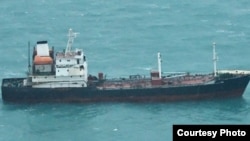
Two North Korean oil tankers sanctioned by the United Nations Security Council have been repeatedly spotted off China’s coast, according to the public record by vessel-tracking Marine Traffic website, raising concerns that they may be circumventing sanctions while continuing to operate at sea.
The vessels, NAM SAN 8 and CHON MA SAN, have previously been suspected of engaging in prohibited ship-to-ship transfers, according to local media reports. A former member of a U.N. panel of experts on North Korea sanctions said their movements raise concerns that they could be using at-sea transfers to evade sanctions.
According to MarineTraffic, NAM SAN 8 was spotted on Oct. 24 near Xiaoqu Shan, in the Hangzhou Bay and Ningbo-Zhoushan area off eastern China. CHON MA SAN was also detected near Tang Yu on the same day, having moved south from its previously observed position.
Neil Watts, a former member of the U.N. Panel of Experts on North Korea sanctions, told VOA in an email on Oct. 23 that tracking images showed both vessels had spent time in territorial waters among the islands in the Ningbo-Zhoushan area, which he described as “an area synonymous with illicit ship-to-ship transfers of cargo from North Korean vessels.” Such transfers allow cargo to be moved between vessels at sea without entering a port, potentially making it more difficult to trace the cargo’s origin and destination.
Both the CHON MA SAN and NAM SAN 8 were added to the U.S.'s sanctions list in 2018 and are subject to port bans and asset freezes, Watts said.
“By not entering port and doing transfers at sea, they are using a ‘workaround’ tactic to create plausible deniability and thereby skirt around the consequences of their designation,” he said.
Both tankers are subject to an asset freeze and a ban on entering the ports of U.N. member states, including China.
Under Security Council Resolution 2397, member states must seize, inspect and impound vessels in their ports and may take similar measures against vessels in their territorial waters when there are reasonable grounds to believe they have been involved in prohibited activities or transported prohibited items. The U.S. Treasury Department’s Office of Foreign Assets Control (OFAC) placed both ships on its Specially Designated Nationals List. That designation bars any American dealings with both craft.
“It is concerning that these tactics seemingly enable these vessels to escape the consequences of their designation and keep operating when the designations were intended to stop their illicit activities that are in violation of U.N. Security Council sanctions,” Watts added.
VOA requested comment from the Chinese government on the vessels’ activities and China’s enforcement of the relevant sanctions but received no response.