


Editor's note: this story was translated from the original VOA Ukrainian article.
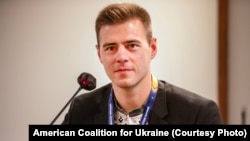
Ukrainian skeleton racer and Olympian Vladyslav Heraskevych recently visited Washington, D.C., for the Ukraine Action Summit to advocate against Russian aggression. He gained international prominence after being disqualified from the 2026 Winter Olympics for wearing a helmet honoring Ukrainian athletes killed in the war. During his visit, Heraskevych actively campaigned to prevent Russian athletes from participating in the upcoming 2028 Los Angeles Olympics.
A U.S. State Department spokesperson told VOA it is well prepared to welcome legitimate travelers from around the globe for the 2028 Summer Olympics and will not waver in upholding U.S. law and the highest standards of national security and public safety in the conduct of our visa process. The State Department noted that that each visa application is adjudicated on a case-by-case basis after rigorous review and thorough vetting to determine whether the individual is eligible under U.S. law.
The International Olympic Committee (IOC) provisionally lifted its suspension of Russia in July, paving the way for Russian teams to return to the Olympic fold ahead of the 2028 Los Angeles Games. IOC President Kirsty Coventry said in July that athletes should not be punished for the actions of their governments.
Ukraine’s sports minister Matvii Bidnyi questioned why the IOC altered its rules when in the war “nothing changed." "The situation became even worse,” he told The Associated Press after the IOC decision was announced.
Mariia Prus, Voice of America: Vlad, this isn't your first time in America, but it is your first time in Washington. What are your impressions?
Vladyslav Geraskevych, skeleton racer and Olympian: I really like it here. I really like how clean it is. I like the architecture. I like seeing so many people gathered here who are standing up for Ukraine—civil society organizations, advocates for Ukraine, and charitable foundations helping veterans and children, as well as those working to bring children back home. Many non-Ukrainians are helping Ukraine by consciously visiting the country and experiencing firsthand what is happening [there].
M.P.: Did you come here specifically for this, or did you combine it with other things? Tell us how you ended up here and what your mission is.
V.H.: I was asked to participate in the Ukraine Action Summit. I joined the specific part of the summit I was invited to. Another aspect of our work—a joint project with Razom for Ukraine—focuses on advocacy regarding the exclusion of [Russian] athletes. This is a crucial issue that often falls outside the scope of standard diplomatic efforts.
Many people claim that sport is separate from politics. During this trip, we are trying to demonstrate and explain that this is not the case. Sports play a significant role in politics. For years, Russia has actively used sport in its political agenda and propaganda.
We are advocating against allowing Russian athletes to participate in the 2028 Olympic Games, which will be held here in America — in Los Angeles. It is a massive media platform that Russia would inevitably exploit for propaganda purposes if its athletes were permitted to compete under their national flag and anthem.
M.P.: The International Olympic Committee’s latest decision suggests that Russians might be allowed to compete under their own flags. Do you feel there is still a chance to influence this decision — to prevent Russians from participating or to ensure they compete under neutral flags?
V.H.: We have the IOC’s final decision, which revoked the recommendations to suspend Russian athletes. Of course, this didn’t come as a shock to us, as this is part of a systematic pattern. We had seen many signs that this would happen.
And, incidentally, it is an interesting fact that it is precisely people from authoritarian regimes — and those who sided with such regimes — who speak most loudly about the neutrality of sport and the idea that sport is separate from politics. Athletes involved in Russian initiatives like "Yunarmiya"—working with Ukrainian children who have been deported — claim that sport bears no blame in this matter.
That is precisely why we are now initiating work on visa bans for Russian athletes; it represents a real opportunity to change the situation. Latvia provides an example: during the Luge World Cup, Russian athletes were effectively barred from competing simply because they could not obtain visas and were unable to enter the country.
After all, sports do not exist in a vacuum. Competitions take place in specific countries and specific cities. If athletes cannot get there, they cannot participate in those competitions. That is precisely our goal for the 2028 Olympics: to ensure that Russian athletes who support the war simply cannot enter the United States and participate in the Olympic Games.
M.P.: Is it difficult to lobby for Ukraine right now? Is it hard to talk about excluding Russian athletes at this moment? You’ve spoken in various interviews about this "fatigue" — is it fatigue with Ukraine itself, or fatigue with the topic of the war? In other words, are there other arguments you can use?
V.H.: There certainly are. There is even a specific term for it — "war fatigue." And that is a problem, because the war doesn't end just because of that. Ukraine is definitely appearing much less frequently in the news. That is why it is so valuable right now to seize any opportunity — literally any opportunity — to talk about Ukraine.
The scale of the war is currently growing. At the same time, attention to Ukraine abroad is diminishing, creating the illusion that things are improving. But that is not the case. The problem is obvious and multifaceted. One aspect is the way the war is covered: tragic events are often presented merely as statistics, making it difficult to feel any real connection to the numbers. We need to move beyond dry statistics and tell stories — to unpack the narrative.
That is precisely why the incident involving my helmet — when I was disqualified — resonated so deeply with audiences around the world; it became relatable and human. We weren't just talking about the thousands of people dying every day; we were talking about athletes. Yet, through stories like that, people could better grasp what Ukraine is going through right now.