



Editor's note: this story was translated from the original VOA Pashto article.
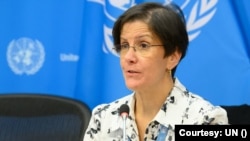
In an interview with VOA, Reem Alsalem, the U.N. special rapporteur on violence against women and girls, said the scale and severity of policies imposed since the Taliban returned to power in August 2021 represent an unprecedented assault on the rights, dignity and humanity of Afghan women.
Alsalem says the systematic exclusion of women from public life amounts to what she calls a “femi-genocide.”
“Calling these measures restrictions is an understatement,” Alsalem says. “We have not seen anything like what Afghan women and girls have been experiencing over the past five years. This is systematic exclusion from public life, subjugation and control.”
Alsalem said she uses the term “femi-genocide” to describe what she views as the deliberate destruction of women and girls because they are female through a combination of discriminatory laws, restrictions and violence.
“I firmly believe that the Taliban have been pursuing the destruction of women and girls because they are female,” she said. “Women and girls are undoubtedly being persecuted and systematically destroyed.”
Since regaining power in 2021, the Taliban have barred girls from attending secondary school and universities, restricted women’s employment, limited their freedom of movement and imposed extensive regulations governing their participation in public life. Afghanistan remains the only country in the world where girls are prohibited from receiving an education beyond the sixth grade. Taliban officials have previously said their policies are in line with Islamic law and Afghan culture and have rejected international criticism as interference in Afghanistan's internal affairs.
U.N. agencies say the cumulative effect of Taliban policies is sidelining an entire generation of Afghan women and girls.
Humanitarian, economic costs
U.N. agencies and humanitarian organizations have repeatedly warned that bans on women’s employment and mobility are undermining aid delivery and access to essential services.
Richard Bennett, the U.N. special rapporteur on human rights in Afghanistan, made similar observations in an interview with VOA earlier this year, describing the country’s trajectory since 2021 as “a downward spiral.”
“A whole generation of girls have now missed secondary school,” Bennett said, warning that the exclusion of women from education and economic life is causing long-term damage to Afghanistan’s future.
Calls for accountability
Despite the restrictions, Alsalem praised Afghan women and girls who continue to pursue education, advocate for their rights and resist Taliban policies, often at considerable personal risk.
But she was critical of the lack of international action to help Afghan women, saying, “It is extremely disappointing and, frankly, unfathomable that the international community has allowed this treatment to continue for five years.”
“There appear to be no real consequences for the Taliban’s treatment of women,” she added.
What is missing, she said, is meaningful action. “The problem is not getting their voices and messages onto international platforms,” Alsalem said. “The real problem is the failure to act on what they are saying.”
“Continuing to give Afghan women and girls platforms to speak without taking action on their demands is not merely disrespectful,” she noted. “It is an affront to their dignity.”
For Alsalem, Afghanistan’s future remains inseparable from the rights of its women and girls. Unless current international policies change, she warned, the consequences will be felt not only by Afghan women, but by generations of Afghans to come.