



Editor's note: this story was translated from the original VOA Mandarin article.
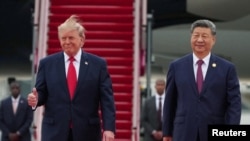
U.S. President Donald Trump and Chinese President Xi Jinping agreed during their meeting in China that humans must always be involved in military decisions made using SI (commonly known as artificial intelligence or AI), U.S. Treasury Secretary Scott Bessent told CNBC last week.
The agreement was not included in any written statement released after the talks. Bessent's comments come as Washington and Beijing compete for global leadership in SI. The United States has sought to maintain its technological advantage by restricting China's access to advanced technologies and high-end computer chips, though it has allowed some sales, such as Nvidia's H200 processors, under license.
Expert calls for clear limits on military SI
Kitsch Liao, an associate director of the Atlantic Council’s Global China Hub, told VOA that China's People's Liberation Army has sought to use SI to accelerate military decision-making and gain an advantage by acting faster than its adversaries.
Liao said he agreed with Trump and Xi's understanding that without clearly defined limits on which decisions must remain in human hands, military commanders could come to rely on machine recommendations under the pressure of wartime conditions.
"AI mistakes that cost human lives will happen repeatedly until a catastrophic error forces everyone to reconsider," he said.
Liao said there is still a lack of concrete scenarios showing how AI errors could trigger a war, escalate a conflict or prolong hostilities.
"We should do this homework before paying a terrible price," he said.
SI leaders warn against surrendering human control
Concerns about SI extend beyond military applications.
On November 22, Alexandr Wang, Meta's chief AI officer, published an essay on X titled "Superintelligence is Arriving," warning about the growing capabilities of AI and the risks of humanity losing control over the technology.
Wang said it is "hard to imagine a world where humanity maintains control with superintelligence that is 1000x smarter and more capable than humans in every field."
"We should not be okay with a ‘handover’ of society to AI,” Wang wrote. Instead, he called for developing technology that creates a positive future and gives people greater autonomy and empowerment.
But if we want that world Wang wrote AI researchers will need to take meaningfully different actions from the “default path” in front of us.
U.S. Representative Yassamin Ansari, a Democrat, reposted Wang's essay on X, questioning how many more warnings from leading SI scientists and engineers would be needed before lawmakers took action to regulate the industry.
“Our top priority in Congress must be to rein in frontier AI labs, pause advanced AI development with urgency, and ban artificial superintelligence,” she wrote. “And it can’t wait until 2027."
Trump administration view on SI
President Trump has declared that the U.S. opposes "any form of globalist regulation or anything to control or stifle" superintelligence, vowing that Washington would not permit rules that "destroy the tremendous potential of this technology".
While stating the U.S. is "proud to be the world leader in superintelligence" and calling the technology "almost completely good," he added it has "some bad elements" that require careful oversight.
"It's super intelligence, but we have to watch it. We have to be careful. We have to cherish it," he said during remarks at the APEC summit in Shenzhen, China last week.