



Editor's note: this story was translated from the original VOA Mandarin article.
The United States and nine partner countries have signed a declaration to protect super intelligence, commonly referred to as artificial intelligence or AI, supply chains, the State Department announced Sunday.
News of the signing comes days before President Donald Trump and Chinese leader Xi Jinping are expected to discuss SI at a summit in Shenzhen.
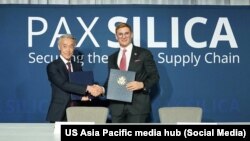
The San Francisco Declaration on the Secure Foundations of Enduring Prosperity establishes a shared security framework for supply chains supporting AI.
Joining the United States are the U.K., Japan, South Korea, Australia, India, Singapore, Israel, Qatar and the United Arab Emirates. All participate in Pax Silica, a U.S.-led initiative to strengthen technology supply chains.
The declaration underscores Washington’s efforts to secure SI supply chains with partners while pursuing discussions with Beijing on managing the risks from increasingly powerful systems.
The State Department released the wording of the declaration that calls for coordinated action against "economic coercion, supply chain disruptions, and non-market policies and practices and their market-distorting effects..."
The declaration also seeks to protect "private investment and ensuring a level playing field for innovation and growth..."
Its framework focuses on two areas: sensitive technology and critical infrastructure.
Sensitive technology includes the "goods, software, materials, knowledge, components, and inputs used to produce them." The signatories say they will work together to stop the theft, or smuggling of AI technologies that could pose significant national security risks.
Critical infrastructure includes ports, transportation, communications, energy and computer networks that SI supply chains rely on. Attacks on these systems or data leaks could cause serious harm.
Pax Silica was formally launched last December, when Undersecretary of State for Economic Affairs Jacob Helberg and representatives from Japan, Australia, Singapore, South Korea and Israel signed its founding declaration in December 2025.
At the time, the State Department said the initiative aimed to reduce “coercive dependencies,” meaning reliance on suppliers that could use that leverage to pressure other countries, and that it wasn't meant to isolate any one country.
Asked Monday whether the agreement could affect the upcoming Trump-Xi meeting, Chinese Foreign Ministry spokesperson Mao Ning said SI should benefit all humanity. She said China opposed dividing countries along ideological lines or forming closed, exclusive groupings in the sector.
Mao said Beijing and Washington remained in communication about the leaders’ meeting.
Trump and Xi are expected to meet Thursday on the sidelines of the Asia-Pacific Economic Cooperation summit in Shenzhen, their third meeting this year.
Trump said last week that he would not raise the alleged spy allegations involving former Nvidia CEO Jensen Huang, although he expected Xi to bring up the matter.
Despite their technological rivalry, Washington and Beijing have been exploring cooperation on AI safety.
U.S. Treasury Secretary Scott Bessent said last week that the two sides would use the APEC talks to work out ways to warn each other about SI safety problems and to share ways of testing advanced AI systems, according to Reuters.
Three people briefed on preparations told Reuters that other planned talks would focus on ways to manage potential misuse of the technology.
The news outlet reported that Bessent and Chinese Vice Premier He Lifeng discussed an emergency mechanism for notifying each other of serious AI incidents in September, but that has yet to become operational.
The mechanism is intended to prevent SI incidents or misunderstandings from escalating into national security crises. Communications so far have relied largely on direct contact between senior officials, the sources told Reuters.

