


Editor's note: this story was translated from the original VOA Persian article.
A senior American official has reiterated President Donald Trump's recent threats to resume military action against Iran's Islamic regime if refuses to stop its threatening activities.
"Unless they change their ways, rapidly, we will soon finish the job," the official told VOA on background in a Monday email. The official was responding to a request for comment on the Iranian regime hosting a meeting earlier in the day with senior officials from Saudi Arabia, Pakistan and Turkiye.
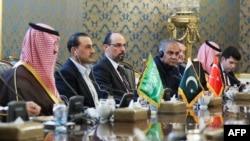
Saudi Defense Minister Prince Khalid bin Salman, Pakistan’s Army Chief Field Marshal Asim Munir, and Head of Turkish Intelligence Ibrahim Kalin arrived in Tehran on Monday and met with Iranian President Masoud Pezeshkian, Supreme National Security Council Secretary Mohsen Rezaei and Iranian Foreign Minister Abbas Araghchi.
There were no immediate readouts of the talks from Riyadh, Islamabad or Ankara, three nations that formed a mutual defense alliance known as the Mecca Agreement in August.
Ahead of the Tehran meeting, a statement from the Saudi foreign ministry said it was part of an effort by the Mecca Agreement countries to "de-escalate between the parties to the current crisis, encourage dialogue and diplomatic solutions, and support mediation efforts of Qatar and Pakistan."
The U.S. launched a joint offensive with Israel against the Iranian terror regime on February 28, severely damaging its nuclear weaponization program and other malign capabilities. Major combat ended with a Qatar- and Pakistan-mediated April truce that has largely held, with the U.S. carrying out several rounds of retaliatory strikes for Iranian attacks that violated the ceasefire.
The intense period of U.S. and Israeli strikes on Iran also saw the regime retaliate with aerial attacks on America's regional Arab partners including Saudi Arabia.
The U.S. official who provided the background comment to VOA said Trump “holds all the cards and will do whatever is best for the United States." Describing the Islamic republic as a "failed country," the official added: "The United States is in a very strong position with control of the Strait of Hormuz and the Iranian economy collapsing."
The official noted that "crushing" U.S. sanctions and naval blockades that have prevented Tehran from exporting its oil have crippled Iran’s economy and left it "completely broke."
"Iran has been decimated, and one way or the other, the conflict in Iran will be over very soon," the official said.
Referring to the Iranian regime, the official further added: "Their military was decimated by Operation Epic Fury, and they are unable to pay their troops. The Hormuz Strait is open and tens of millions of barrels of oil are escorted out of the Strait every day."
The Iranian regime has warned against an escalation of the conflict and threatened to widen hostilities if attacked again. In an opinion piece in the Financial Times last week, Araghchi also said his country was ready for diplomatic resolution.
President Trump told reporters last Wednesday that he was not negotiating with Iran and predicted that a new Iran-related development will happen "fairly soon."