


Editor's note: this story was translated from the original VOA Mandarin article.
The U.S. has rejected China's claim that a U.S. warship trespassed its territorial waters and urged Beijing to halt its "aggressive" maneuvers in the South China Sea.
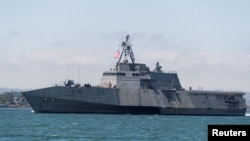
China on Tuesday dispatched naval forces to monitor the transit of the USS Charleston near the disputed Sabina Shoal in the South China Sea.
A spokesperson for China's military on Tuesday accused the U.S. of “infringing upon China’s sovereignty rights and interests.”
Chinese official media outlets described the littoral combat ship’s passage as an “unauthorized trespassing.”
The U.S. rejects China's claim and asserted that Beijing's attempted enforcement of its “unlawful maritime claims” undermines regional stability.
Washington has also accused Beijing of asserting what it terms as "unlawful maritime claims in most of the South China Sea.”
“The United States will fly, sail, and operate wherever international law allows, including the South China Sea," a spokesperson for the State Department said in response to VOA inquiry about the China's criticism of the passage of USS Charleston.
“Freedom of the seas and adherence to the international law of the sea is vital for the entire international community,” the spokesperson added.
But does China have the right to require U.S. warships to provide prior notification—or even obtain approval—before passing through the Sabina Shoal? Regardless of the sovereignty claims, how does the physical and geographical location of Sabina Shoal relate to this dispute?
Does Sabina Shoal have territorial rights under international law?
Sabina Shoal, a coral atoll in the contested Spratly Islands, is located approximately 75 nautical miles west of the Philippine island of Palawan.
The Philippines, which refers to it as Escoda Shoal, considers it to be within its 200-nautical-mile Exclusive Economic Zone (EEZ). China, which claims almost all of the vast South China Sea as its territory, refers to the shoal as Xianbin Reef.
A key point of contention concerns how Sabina Shoal is classified as a natural feature and the maritime rights it may—or may not—generate under international maritime law.
Peter Dutton, a senior research scholar in law and senior fellow in the Paul Tsai China Center at Yale Law School, argues that the shoal has no territorial sea or other entitlements.
He says that Sabina Shoal is a "low-tide elevation," which has specific legal connotations under Article 13 of the United Nations Convention on the Law of the Sea (UNCLOS).
"It is a low tide elevation, meaning there is no part of the shoal that is permanently above water," he told VOA. “The law considers low tide elevations to be part of the continental shelf of the nearest coastal state. In this case, that is the Philippines."
The waters surrounding the shoal are in an area of high seas freedoms unless the territorial sea of another nearby feature encompasses the shoal, Dutton argues.
"But even in that case, warships such as the USS Charleston are legally entitled to undertake ‘innocent passage’ around the shoal," he said.
Does China have the right to demand prior notification from U.S. warships?
China’s 1992 Law on the Territorial Sea and the Contiguous Zone requires foreign military vessels to obtain approval from the Chinese government before entering China’s territorial sea, a position disputed by experts.
Lowell Bautista, an Associate Professor at Western Sydney University School of Law in Australia, believes that China cannot, based solely on its own sovereignty claims, mandate that foreign warships obtain permission or provide advance notification before navigating through these waters.
Citing Articles 58 and 87 of the UNCLOS, Bautista says vessels of all states—including warships—enjoy freedom of navigation within an EEZ and generally do not require prior authorization from the coastal state.
"China argues that foreign military activities in an EEZ require its consent, but that view is not supported by the convention and is rejected by most maritime states," he told VOA. "In any case, a transit is an exercise of navigation, the most basic freedom the convention protects."
Bautista says that although the U.S. is not a party to UNCLOS, it accepts and adheres to many of the convention’s rules regarding freedom of navigation as a matter of customary international law. China, by contrast, is a party to the convention and is bound by its provisions, he said.
US call to China
The U.S. has urged China to "cease its dangerous and aggressive behavior."
The State Department spokesperson also called on China to comply with its treaty obligations to comport its maritime claims in the South China Sea to the requirements of the 1982 United Nations Convention on the Law of the Sea and the 2016 Arbitral Tribunal ruling.
“China’s attempted enforcement of its unlawful maritime claims undermines regional stability, as well as the legal rights and freedoms of the United States and all other countries and claimants," the spokesperson said, highlighting the importance of the freedom of the seas and adherence to the international law.
In July 2016, an international arbitral tribunal in The Hague ruled that there is no legal basis for China’s expansive maritime claims in the South China Sea.
Beijing rejected the ruling.
The U.S., the Philippines and 12 other nations issued a joint statement last July reaffirming that The Hague ruling is “final” and “legally binding.”