


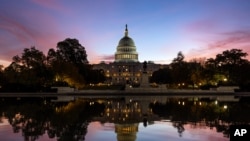
VOA is joining projections that Democrats have won the Senate majority. They have flipped six Republican seats, in Tuesday’s midterm elections, some of them deep in traditionally Republican held territory including Texas and South Carolina.
While Republicans may still flip some seats in traditional Democrat territory, the Democrats are projected to have won enough key seats to take control of the U.S. Senate.
The Democratic party is seeking to control both chambers in the final two years of President Donald Trump's term.
In the key races, Democrat Roy Cooper won in North Carolina, defeating Republican Michael Whatley and Democrat Annie Andrews won in South Carolina, defeating Darline Graham. Graham was the sister of former Republican Senator Lindsey Graham, who died earlier this year.
In Texas, Democrat James Talarico defeated Republican Ken Paxton, becoming the first Democrat to win a Senate seat in the state since 1988.
In Ohio, Democrat Sherrod Brown has defeated Republican incumbent Senator Jon Husted
Adam Hamilton will become the first Democrat to hold a Senate seat in Kansas in 94 years, after defeating Republican incumbent Senator Roger Marshall.
And in Iowa, Democrat Josh Turek won that Senate race, defeating Republican Ashley Hinson.
Democrats came into Election Day seeking at minimum a net gain of four seats to take back control of the Senate from Trump’s Republican Party.
In other closely watched Senate races, incumbent Democratic Senator John Ossoff won in Georgia, while incumbent Republican Senator Ashley Moody won another term representing Florida.
Republican Harriet Hageman won an open Senate race representing the state of Wyoming, while Republican Andy Barr won in Kentucky and Republican Kevin Hern won in Oklahoma. All three seats were previously held by Republicans. Democrats held onto open Senate seats with wins by Democrat Juliana Stratton in Illinois and Democrat Chris Pappas in New Hampshire.
At the time of writing, incumbent Democrats had won new six-year terms in the Senate in Virginia, Massachusetts, Rhode Island, New Jersey, Colorado, New Mexico and Delaware. Incumbent Republicans had won Senate races in Arkansas and West Virginia.
Trump commented on the election late Tuesday, saying on his Truth Social platform: "I wasn't on the Ballot and if I was, we would have won IN A LANDSLIDE!"
Polls close in the evening hours local time across the country’s 50 states, with results coming in the hours—and sometimes days—that follow.
All 435 seats in the U.S. House of Representatives were up for election Tuesday along with 35 of the Senate’s 100 seats. Results are still coming in but Democrats have won several key races.
Republicans held a slim majority in both chambers heading into the election, while the Democratic Party was hoping to flip enough seats in its favor to take back control of the legislative body.
Those elected Tuesday will begin their terms in Congress on January 3.
In addition to the U.S. congressional races, there were also elections for governor in 36 states, as well as members of state legislatures and other local races.
Democrat Keisha Lance Bottoms won the Georgia governor race, while Republican Byron Donalds won election to be Florida’s governor.
Republicans held a slight edge in state governorships going into Election Day. The last time Democrats won enough races to control a majority of those positions was in the 2006 election.