S. Korea Ferry Death Toll Reaches 150, Search for Victims Continues
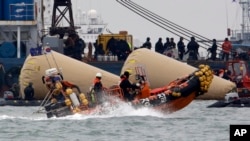
FILE - Searchers and divers look for people believed to have been trapped in the sunken ferry boat Sewol near the buoys which were installed to mark the vessel in the water off the southern coast near Jindo, south of Seoul, South Korea, April 22, 2014.
The confirmed death toll from the South Korean ferry disaster climbed to 150 Wednesday, one week since the passenger boat capsized off the country's southwest coast.
Divers are slowly working their way through the third and fourth floors of the Sewol ferry. The boat is submerged upside down in murky waters and surrounded by a strong ocean current.
Coast Guard official Ko Myung-suk said divers will soon be helped by the arrival of high-tech underwater search equipment.
"We're planning to mobilize a multi-legged underwater robot and a side scan sonar. This means that we will mobilize various equipment and methods as much as we can, if it is going to help with the rescue operation," said Ko.
More than 150 other passengers are missing and presumed dead, bringing the expected final death toll to around 300. That would make it South Korea's worst ferry disaster in two decades.
Search and Rescue Attempts for Sunken Ferry
1/9Family members of a missing passenger from the capsized passenger ferry, Sewol, wait for news of the rescue operation at a makeshift accommodation, in the port city of Jindo, April 23, 2014.
Show moreShow less
2/9Women wearing protective suits spray antiseptic solution around the tents of volunteers who distribute food and necessities for relatives of missing passengers of Sewol, in Jindo, April 23, 2014.
Show moreShow less
3/9People pray during a candlelight vigil to commemorate the victims of capsized passenger ferry Sewol and to wish for the safe return of missing passengers, in Ansan, Korea, April 23, 2014.
Show moreShow less
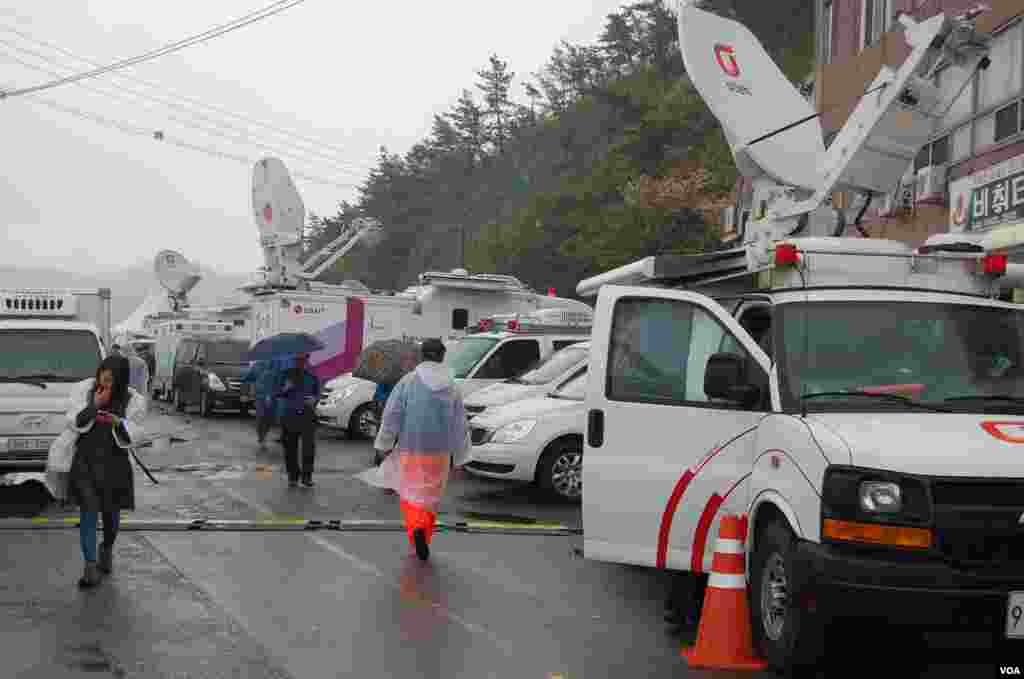
4/9Satellite trucks for members of the press reporting on the sunken ferry, Sewol, in Jindo, April 18, 2014. (Sungmin Do/VOA)
Show moreShow less
5/9A Buddhist monk prays for the missing passengers who were on the South Korean ferry, Sewol. Family members, rescue staff and members of the press gather at the port, Jindo, April 18, 2014. (Sungmin Do/VOA)
Show moreShow less
6/9A rescue diver jumps in near the buoys installed to mark the location of the sunken ferry Sewol off the southern coast, near Jindo, April 18, 2014.
Show moreShow less
7/9This giant offshore crane will be used in the rescue operation of the capsized passenger ferry Sewol. Seen here, it is moving into position as members of the South Korean Navy's SSU (Ship Salvage Unit) take part in the rescue operation, Jindo, April 18, 2014.
Show moreShow less
8/9A family member of a missing passenger on South Korean ferry Sewol cries as she waits for news from a rescue team, Jindo, April 18, 2014.
Show moreShow less
9/9A family member of missing passengers who were on the Sewol ferry looks toward the site of the incident, Jindo, April 18, 2014.
Show moreShow less
Previous slide
Next slide
After the bodies are recovered, they are brought to nearby Jindo island. Inside the tents where the corpses are held, cries can be heard each time a relative identifies a victim.
The disaster has shocked South Korea. There is widespread public anger at the crew of the ship for abandoning the vessel before the evacuation was completed.
The captain was not operating the vessel at the time of the sinking, leaving an inexperienced third-mate in charge. The captain and six crew members are under arrest. President Park Geun-hye has said their actions were "tantamount to murder."
The crew has said they were reluctant to evacuate the passengers because they feared they would not survive the cold waters and strong ocean current. They also say the ship was listing heavily, making it hard to free lifeboats.
The Sewol was carrying 476 passengers. Most were high school students who were headed for an outing on the resort island of Jeju.
Authorities are still investigating why the 6,800-ton boat capsized. Tracking data shows it made a sharp turn and began leaning heavily to one side before beginning to sink.
The Voice of America provides news and information in more than 40 languages to an estimated weekly audience of over 326 million people. Stories with the VOA News byline are the work of multiple VOA journalists and may contain information from wire service reports.