



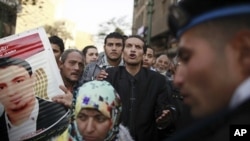
An Egyptian scholar said Egyptians are outraged over Wednesday’s stadium violence that left at least 74 people dead and hundreds injured following a soccer match in the northern city of Port Said.
Said Sadek, a professor of political sociology at the American University in Cairo, said a majority of the people blame the military administration and security agencies for failing to prevent the violence.
“When this happened, there is this conspiracy that the police are taking revenge against the ultras [fanatical sports fans]. It was like a war. Why did this happen and why was security lax?” asked Sadek. “The demonstrations and activities on social networks put the blame on the police and the army.”
Tens of thousands of Egyptian protesters have demonstrated in Tahrir Square, while others marched to the nearby Interior Ministry where riot police fired tear gas to keep them away.
Egypt's military-appointed Prime Minister, Kamal al-Ganzuri, said the government fired the board of Egypt's soccer federation and suspended Port Said's governor and security chiefs in response to the disaster, one of the deadliest in the history of the sport. He announced the actions at an emergency parliament session.
Many groups, including members of parliament who held an emergency meeting, have demanded an investigation into Wednesday’s stadium violence. The International Federation of Association Football (FIFA), the world authority soccer organization, also underscored the need for an investigation into violence at the stadium.
But, Sadek says it is unlikely to have an unbiased inquiry into the stadium tragedy.
“We don’t have any independent investigative team…so, you will see a cover up. Most of the regimes in the Middle East, like in Egypt, are police intelligence states and they are very fit [able] in covering up evidence and covering their tracks,” continued Sadek. “That’s why there is a lot of suspicion about what is happening. For example, the trial of [Mr.] Mubarak; some consider that a mockery, a charade just to appease the public.”
Analysts say the ultras played a pivotal role in the Arab Spring that forced longtime President Hosni Mubarak to step down. Sadek said many Egyptians are suspicious the failure of security forces to prevent the violence was an act of vengeance following the recent pro-democracy uprising that forced Mubarak to step down.
“We have seen in the state-run media that all those who took part in the revolution are being punished and discredited,” said Sadek. “The lack of transitional justice in the country is creating tension. People are becoming irritably violent. They just feel nothing is happening and that, despite the revolution, the forces of conservation and anti-revolution are gaining the upper hand, and they want to suppress the people.”