


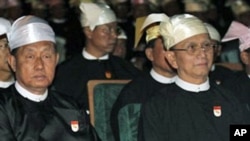
Burma’s military government has been officially dissolved and a nominally civilian government sworn in after decades of military rule. Military loyalists, however, still dominate the new government.
Burma’s state media Wednesday declared the military government officially dissolved and power turned over to what it is calling a civilian-led government.
Former Prime Minister Thein Sein was sworn in as president, along with a new administration chosen after a controversial election in November. The historic handover, though, is tempered by concerns that military rule will continue through proxies loyal to the military.
Democracy leader Aung San Suu Kyi was banned from participating and her National League for Democracy, the main opposition, was disbanded as a political party for boycotting the election.
Nyan Win, a spokesman for the NLD, said they accept the fact that there is a new government and are open to dialogue, but also will be watching closely for signs of military control.
"We are also wait and see about this. We are always concern about military control over the government or not. We don't know exactly. We will wait and see," said Win.
The military government touted the election as a move to democracy, but it was widely condemned as a sham.
The military-drafted constitution guaranteed it a quarter of all seats, and the military-supported party was elected by a landslide amid accusations of voter fraud and intimidation.
Many military officers resigned their posts to run in the election - including the new president, himself a former general - and are considered loyalists.
Smaller democracy parties were elected, but only to a handful of seats.
The role of senior General Than Shwe in the new government is still not clear and some analysts expect him to wield power behind the scenes.
The military government, known formally as the State Peace and Development Council, has ruled Burma since 1988, but the impoverished country has been under some form of military rule for half a century.
The NLD won Burma’s last election in 1990, but the military ignored the results and kept Aung San Suu Kyi locked up for most of the last two decades. She was released from house arrest last year, just days after the election.