



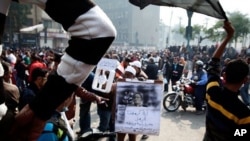
Thousands of Egyptians are pushing into Cairo's Tahrir Square for what protest organizers are calling a "million man march."
Demonstrators have been demanding that the country's military rulers cede power to a civilian authority.
As crowds pressed into the square Egyptian Field Marshal Mohamed Tantawi was holding a crisis meeting with political leaders - a round of emergency talks aimed at preventing further clashes between security forces and demonstrators. State television says he will deliver address the nation later Tuesday.
Television video from the square has shown demonstrators waving huge Egyptian flags and chanting slogans.
Some protesters carried a coffin that is said to contain the body of a demonstrator killed in an earlier rally. Egypt's Health Ministry says at least 29 people have died in protests over the past four days, during clashes between authorities and demonstrators. Three people died early Tuesday in the Red Sea port city of Ismailiya.
The demonstrations are the largest to take place in Egypt since anti-government protests forced former President Hosni Mubarak to resign in February. The protests are unfolding ahead of parliamentary elections set to begin on November 28.
In an online post, a coalition of revolutionary youth groups called for the immediate resignation of Prime Minister Essam Sharaf's civilian Cabinet and formation of a national unity government. The Cabinet offered to step down on Monday but will continue to perform its duties until the military council decides whether to accept the resignations.
In a bid to end days of deadly clashes between security forces and protesters, the ruling Supreme Council of the Armed Forces asked political parties and other actors to join emergency talks.
Egypt's largest Islamist group, the Muslim Brotherhood, and four other parties were expected to attend Tuesday's deliberations, but there has been no indication the youth groups driving the protests would take part.
In an apparent concession to demonstrators, the military council issued a law that bans anyone convicted of corruption from running for office or holding a government position. The move could restrict members of Mubarak's former ruling party from competing in upcoming elections.
Amnesty International on Tuesday accused Egypt's rulers of brutality sometimes exceeding that of Mubarak. Hundreds have been injured nationwide during the unrest.
Some information for this report was provided by AP, AFP and Reuters.
| Join the conversation on our social journalism site - Middle East Voices. Follow our Middle East reports on Twitter and discuss them on our Facebook page. |