



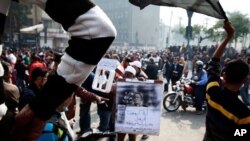
The vice president of Egypt’s Democratic Front Party, Mohammed Mansour Hasan, says the ruling military council’s latest decision has failed to meet the expectations of anti-government protesters who demand the leadership steps down.
In a speech late Tuesday, the head of the Supreme Council of the Armed Forces, Mohamed Tantawi, announced the rulers have agreed to form a new government and promised to transfer power to a civilian body by July. But Hasan called the announcement a “mini” concession that is unacceptable to the protesters.
“I don’t think the statement meets expectations of the revolutionists in Tahrir Square,” said Hasan. “The problem is that the Supreme Military Council has lost the credibility among those people, and the revolutionists look at them as being the force behind the violence that has been taking place in the past four days.”
Hasan predicts pro-democracy demonstrations will continue despite the promise by the military to hand over power next year.
“I don’t think the statement will resolve the problem and I think the demonstration will continue for the next few days, until another solution is found,” said Hasan.
Tantawi said the current Cabinet would remain in place until a new government is formed. He added that military rulers were prepared to organize a referendum on an immediate power transfer, if necessary. He also said officials are committed to holding parliamentary elections that are set to begin on November 28 and to the election of a new president before July 2012.
Hasan said anti-government protesters could accept technocrats in a new transitional administration as part of a solution.
“If a new Cabinet includes faces that are accepted by the majority of the population and if the military council will include a few consultants within the council itself, I think that will maybe bring confidence to the council,” said Hasan. “There are a few names that are very respected in the Egyptian society. And if they join the military council and become advisors, [it] will give people some hope that we are finally on the right track.”
He described as “impractical” the protestors’ call for an immediate transfer of power to a civilian administration.
Hasan said military rulers have ignored advice offered by his political party.
“Our suggestion is first to postpone the parliamentary elections for a few weeks until the security situation gets better, then transfer power immediately to a civil presidential council and to let that presidential council form a new government. But, apparently, from General Tantawi’s speech, I guess those suggestions, were not accepted,” said Hasan.