



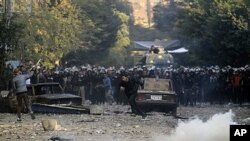
In Egypt, a scholar says anti-government protesters will continue expressing their dissatisfaction with the ruling Military Council until its leadership hands over power to a civilian transitional authority.
Howayda Mostafa, a professor of mass communication at the University of Cairo, says many Egyptians seem to have lost faith in the military and are demanding an immediate transfer of power ahead of next week’s parliamentary election.
“Many people are very afraid of [violence]. Even today, the streets [are] quite empty; only in Tahrir Square is very crowded. But, in other places, people are very afraid of this situation,” said Mostafa.
Her comments came after the cabinet submitted its resignation to the military council following days of deadly clashes between police and pro-democracy protesters.
Mostafa says the anti-government protesters do not have confidence in the ruling body.
“This is the problem because before, many people thought the military is the only power that can protect the people. Now the problem is …people don’t trust them anymore,” said Mostafa. “They [anti-government protesters] want them [the military] to give the power to a civilian government.”
She said the pro-democracy protesters suggest that the military does not want to hand over power to civilians, despite the upcoming parliamentary election.
“They think the Military Council doesn’t want to leave power because they didn’t give a determined date for the transition of power. Even for the presidential election, they didn’t give or determine any time or date,” said Mostafa.
She also said protesters say the military is working to protect is influence in any future government.
“The prime minister launched a new constitutional document which includes many articles [protecting] military power,” said Mostafa. “They [military] want to ensure that nobody can, for example, discuss the budget of the military forces. The protesters see many other articles [in the constitution] as the military wanting to have more power.”
Meanwhile, the military is calling for crisis talks with the country's political forces; one day after the interim civilian cabinet submitted its resignation. The ministers stepped down following three days of protests and a fierce security crackdown that killed at least 24 people.
In a late-night statement, the military council urged calm and called for a national dialogue “to look into the reasons behind the current crisis and ways to resolve it as quickly as possible.”