



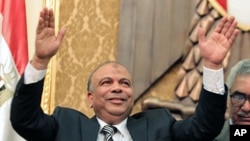
Egypt’s lower house of parliament convened Monday for the first time since democratic elections ushered in a new crop of lawmakers, many of them representing Islamist parties.
Following his nomination last week, Mohamed Saad el-Katatni, who previously served as Secretary General of the Freedom and Justice party, was voted in as speaker of Egypt's lower house with 399 votes on Monday.
Freedom and Justice, the political wing of the Muslim Brotherhood, captured 47 percent of the vote in elections for the lower house of parliament.
Katatni, 60, spent much of his working career in the sciences. He was a botanist and taught botanical microbiology at the university level.
His political career emerged after joining the Muslim Brotherhood and rose through a variety of party positions in the last decade. He was elected to parliament in 2005 and represented the parliament in numerous international conferences.
Katatni is the first Islamist speaker of the house in Egypt’s history.
Katatni has said his priorities include ensuring that Egypt moves quickly toward a democratic state and ending the interim period that began when ex-President Hosni Mubarak stepped aside one year ago
Egypt had been governed by a council of high-ranking military officers.
Political sociologist Said Sadek wonders, though, whether Katatni will be a unifying figure in the new parliament.
"A weak parliament doesn’t enjoy the support of the people," said Sadek. "A strong parliament must enjoy the support of Tahrir [the democracy protest movement]. Which means this parliament must carry out the objectives of the revolution."
Sadek said those demands include reforms for which many Egyptians have waited decades. He says it is the new parliament’s job to ensure reform.
"It must push for transitional justice, purge the Egyptian government, restructure the Ministry of Interior and the security service," Sadek said. "They have to have a new philosophy, new ideas, not the same old policy. Fighting corruption. These are the priorities."
Earlier this week, the liberal Free Egyptians party criticized Katatni, charging that he had been nominated without any input from liberal political groups.
Egyptian liberals did poorly in the parliamentary elections, which were dominated by the Islamist Freedom and Justice Party and even more conservative Salafi parties.
Elections for Egypt’s upper house of parliament, which traditionally has held little power, will begin in February. Presidential elections are scheduled for June.
| Join the conversation on our social journalism site - Middle East Voices. Follow our Middle East reports on Twitter and discuss them on our Facebook page. |