News / Science & Technology

New Evidence of Ancient Lake on Mars

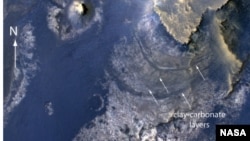
This view of layered rocks on the floor of McLaughlin Crater shows sedimentary rocks on Mars that contain spectroscopic evidence for minerals formed through interaction with water.
TEXT SIZE - +
VOA News
A NASA orbiter flying around Mars is showing evidence of an ancient underground-fed lake at the bottom of a crater, another sign that the planet may have once had life.
 
The Reconnaissance Orbiter spotted carbonate and clay materials inside what scientists have named McLaughlin's Crater, a pit 92 kilometers wide and more than 2 kilometers deep.
 
Such materials can only be formed when water is present. 
 
The scientists say the lack of channels inside the crater means the lake was likely fed from underground.
 
NASA scientist Rick Zurek says the latest findings reveal a more complex Mars than previously thought, with some areas of the planet likely to show signs of ancient life more than others.



You May Like

Karzai to Discuss Enhancing Defense Ties with India

Afghanistan looking for more military aid as it prepares for withdrawal of NATO forces by next year More

India, China Pledge to Overcome Border Tensions

Indian prime minister and Chinese premier attempt to move past tense standoff in the Himalayas during Delhi talks More

Burmese President Opens US Visit with VOA Town Hall Meeting

Ahead of his meeting with President Obama Monday, Thein Sein answered questions on human rights and economic development in his country More

Featured Videos

Your JavaScript is turned off or you have an old version of Adobe's Flash Player. Get the latest Flash player.
Video

Video Valley Fever Raises Concerns in California, Arizona

A longstanding health problem in California's Central Valley has worsened in recent years, leading health officials to order the relocation of 3,000 prisoners from two state prisons. But the disease affects much of the population in some rural communities and, Mike O'Sullivan reports, while it often goes unnoticed, it sometimes can be devastating for patients.