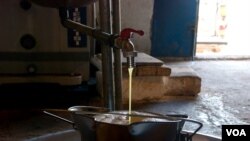
Olive press in the Nafusa Mountains, Libya, April 09, 2012. (Stephanie Figgins)
As Khaled looked out over the now quiet, olive-tree covered hills of Zintan, he recalled the fighting and destruction that rocked this area just a few short months ago. Zintan is a town of 40,000 people tucked into the Nafusa Mountains of northwest Libya. Six thousand Zintanis joined the armed opposition to oust dictator Moammar Gadhafi, forming one of the country’s most formidable militias.
During the eight-month conflict, Zintan’s able-bodied boys and men joined the fighting, its businesses shut down, and electricity and water stopped flowing. Like in the rest of Libya, the economy came to a standstill. In less than one year, the country’s Gross Domestic Product (GDP) contracted by a staggering 60 percent.
For Khaled, who runs the local media center, nursing the economy of his town and his country back to health is among the most critical challenges facing the country’s transitional government.
The focus thus far has been on restoring oil production to pre-war levels. Libya’s oil minister said the country is now producing 1.6 million barrels per day (b/d) of crude oil, just short of the 1.77 million b/d the country was producing before the revolution.
Getting the oil sector up and running should indeed be a primary focus, as hydrocarbons have long dominated the Libyan economy; before the war, oil accounted for over 70 percent of GDP, 95 percent of exports, and nearly 90 percent of government revenue, as estimated by the International Monetary Fund.
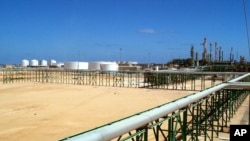
The new Eni (The Italian oil and gas company) gas compression plant in Mellitah, Libya. (file photo)
Moreover, Libya supplies two percent of global output. That its particular brand of “sweet” crude, exported mainly to Europe but also to Asia and the United States, cannot be easily replaced makes it some of the most sought-after oil on international markets.
But some argue Libya’s economic recovery must go beyond restoring the pre-war status quo.
As Michael L. Ross, Professor of Political Science at UCLA, argues in his book The Oil Curse, countries “blessed” with abundant natural resources - particularly oil - also carry a heavy burden. He notes that an over-dependence on the oil sector correlates with a decline in the competitiveness of non-oil sectors, makes the economy vulnerable to swings in international commodity prices, and fosters nondemocratic governments. Indisputably, seemingly endless oil revenues helped keep Gadhafi in power for 42 years.
Moreover, little oil wealth trickled down to ordinary Libyans.
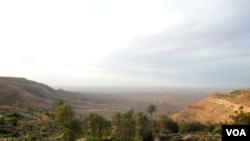
“One of the largest oil pipelines in Libya passed through here,” said Khaled, pointing to two long, white streaks running down the mountainside near his hometown, signaling the pipelines buried below. “But we didn’t benefit at all.”
The pipeline carries oil from the Awbari oilfield in the south to the al-Zawiya refinery in the north, near Tripoli. Opposition fighters shut it down in June 2011 in order to deprive Gadhafi of resources, a move that rebels say was critical to their victory. For Khaled, it was also an important symbolic act, in which regular people reclaimed a pipeline that quite literally bypassed them, funneling Libya’s most precious natural resource north for the benefit of the ruling elite.
Less hydrocarbons, more olives
Consequently, Libya’s post-conflict growth strategy must include a more equitable distribution of oil wealth, but as the IMF argues, it must also involve a reorientation of the economy away from dependence on hydrocarbons.
An olive tree in Zintan, Libya, April 9, 2012. (Stephanie Figgins)
Olives have been an important facet of the economy in the Nafusa Mountain area for thousands of years. The Romans, whose ruins dot the landscape of Zintan, produced olive oil here and exported it to Rome. Olives are also a source of pride for Khaled, who showed me ancient olive presses and explained how to determine the age of an olive tree by counting the number of rings in its trunk. “Land isn’t just for making a living off of,” he said. “The land is our past, present, and future. Our grandfathers liberated the land, protected it.”
However, olives were among the agricultural commodities whose production declined with the 1958 discovery of oil, explains a 2006 report by the MEDFROL project, which analyzes the agricultural sectors of Mediterranean countries. Before 1958, agriculture was the country’s main source of revenue, making up about 30 percent of GDP. With the increase of oil production and exports in the 1960s, the size of the agriculture sector declined rapidly, comprising less than 5 percent of total GDP by 2005.
Now, local business owners and farmers are calling for reforms that would re-focus attention on the agricultural sector.
Outside of Said's olive press in the Nafusa Mountains, Libya, April 9, 2012. (Stephanie Figgins)
Said, 46, owns an olive press a few minutes from Zintan. He recently returned to work, having shut down his factory during the uprising to join the fight against Gadhafi. Now, he wants to get the modern machinery inaccessible before. Under Gadhafi, Said and other farmers in the region were forced to pick their crop by hand, a difficult and time-consuming process that, Said explains, was part of the regime’s strategy to keep its people economically suppressed. With new machines, he hopes he will be able to produce more olive oil and expand his business.
Mohamed talks about farming under the Gadhafi regime, April 9, 2012. (Stephanie Figgins)
Mohamed, 78, inherited his olive farm from his great-grandfather. After finishing secondary school, a distinction only few achieved in the days of his youth, he joined Libya’s bloated civil service. After three decades, Mohamed grew tired of the rampant corruption in his office, so he went to work on his family’s olive farm. But no industry was spared from the corrupt arm of Gadhafi’s government, he said. Most of the oil produced from Mohamed’s olives was sold to the government at reduced prices, and little was made available to regular Libyans.
With the ouster of the regime, he is optimistic that corruption will give way to transparency. And if he could set up irrigation systems and import sophisticated machinery, he would be relieved of trucking in water and harvesting the olives manually.
Getting former fighters back to work
An over-dependence on oil has also contributed to the problem of structural unemployment, a critical factor leading to the uprising against Gadhafi’s oppressive regime. As a capital-intensive industry, the oil sector provides limited jobs. And because oil revenues sustained the government, Gadhafi dedicated few resources to developing human capital.
“Gadhafi wanted us to be so preoccupied with looking for food, a house, a car, that we could not think about other things like higher education,” said Khaled. Before the revolution, he made just 175 Libyan dinar a month, around 140 USD. “A suit costs 120 dinar,” he said. “So the first month of work, you buy a suit. The second month, shoes. After 20 years, you can buy a car.”
Libya’s unemployment problem persists. “Libya has a young population - close to 50 percent are below 25 years of age - with a large influx of entrants to the labor market expected in the next decade,” notes the IMF. Diversification of the economy can serve as a means to create employment opportunities for the country’s youth.
Although many Zintanis have laid down their weapons, the boys and men who fought are now looking to re-integrate into normal life, and they need jobs. But first, Libyan youth will have to be trained in new skill sets to meet the demand of companies that will begin to invest in the economy. “To meet the demand, it will be important to establish training programs for workers and job seekers, and to reform the education system to reflect new needs, such as language and computer skills,” urged the IMF’s August 2012 report Libya Beyond the Revolution: Challenges and Opportunities.
Possibilities ahead
Overlooking a valley in the Nafusa Mountain area, Libya, April 9, 2012. At the far left, white streaks running down the mountain signal oil pipelines buried below. (Stephanie Figgins)
Re-focusing the Libyan economy on non-hydrocarbon sectors is not just about making the economy more stable or equitable. As Khaled indicates, it is also about reawakening the imagination of many Libyans who had been oppressed for decades under Gadhafi.
Zintan’s olive oil industry represents just one facet of the unprecedented economic opportunities available in the post-Gadhafi era. Khaled is floating many other ideas to build up the local tourism and trade industries, both of which, says the IMF, hold many opportunities because of the country’s “rich archeological sites, Mediterranean climate, and proximity to major European markets.”
Khaled imagines building a hotel and a restaurant to cater to tourists that would come to see the Nafusa Mountain’s historical treasures, including its Roman ruins.
The economic challenge ahead is great, and is complicated by the fact that Libya does not yet have a permanent government to carry out long-term policies. In June, the country will elect members to a national assembly tasked with drafting the constitution. Once the constitution passes a referendum, parliamentary and presidential elections will follow - a process likely to take around two years. All of this, amid persistent fears over basic security in a country saturated with weapons.
Regardless of what business ventures Khaled undertakes, for him the economic changes ahead are about achieving something more basic, something that was not possible under the Gadhafi regime: “We want jobs, salaries, to get married, to have babies. We want a normal life. A human life."