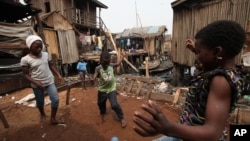
ABUJA — Nigeria's Center for Disease Control says poverty and pollution have reduced the national life expectancy to 47 years old, one of the lowest in West Africa. And while health officials dispute the number, none dispute the urgency of improving health care in the remote rural areas.
There’s a problem in Nigeria that no one disagrees with: when people here die young, they usually die from diseases that could have been prevented or treated.
Doctors say child mortality is rising in places like Zamfara State in the north, where a lead poisoning outbreak has killed more than 400 children under the age of five since March 2010.
Families in the southern Niger Delta region, an area activists call “the world’s largest oil spill,” say their children’s immune systems are weakened from drinking toxic water, and that children frequently die from diseases like cholera and malaria.
Tonye Emmanuel Isenah, a state assembly member in the Niger Delta, says adults in his region are also weakened by the pollution.
“The life expectancy of our people has dramatically dropped," said Isneha. "You can imagine at 45, 40, people are beginning to have strokes.”
Before the country’s Center for Disease Control announced that they calculated a reduction in the national life expectancy figures last week, the World Bank said Nigeria’s life expectancy was just above 51 years old, almost 20 years less than the world average.
Dr. Muhammad Ali Pate, Nigeria’s state minister of health, says he disagrees with the report. He says he believes life expectancy is actually improving as the government implements programs to fight diseases like polio and malaria and provide primary care to children in the countryside.
He agrees with the report in some respects, saying Nigeria’s average life span is dragged down by high death rates among mothers and children.
"Pregnancy is not a disease, yet many mothers die from it. It’s only a subset of pregnant women that will have complications and require interventions but if those interventions are not there or alternative care is not provided, mothers do not know they are at risk," explained Pate.
Dr. Adamu Onu, a family practitioner in Abuja, says health crises across the country have the same root cause: poverty. He says most of the people in Nigeria simply don’t have access to health care because they live far away from the nearest clinic and don’t have the money or the means to travel to the city.
Many people also do not seek trained medical professionals, he says, because they don’t know that doctors can help them live longer than traditional healers. "People are not so educated and they lack access to health care and when they do fall sick they prefer to use alternative medical systems rather than the formal health sector," stated Onu.
Dr. Onu says even when people do seek help, there are almost no doctors in the countryside where most of the population lives.
John Brisbe, an elder in a fishing community in Delta State, says when children in his remote region get sick they often die because it can take up to six hours to get to the hospital in a canoe.
"They are not taking care of any of our communities. So we are suffering," he said. "Different types of sickness are harming our children because of this river water that we are drinking."
Earlier this year, Nigeria’s National Bureau of Statistics released a report that said the number of people living in “absolute poverty” has increased from 54.7 percent in 2004 to nearly 61 percent in 2010, despite the fact that the Nigerian economy, in overall terms, is growing.
There’s a problem in Nigeria that no one disagrees with: when people here die young, they usually die from diseases that could have been prevented or treated.
Doctors say child mortality is rising in places like Zamfara State in the north, where a lead poisoning outbreak has killed more than 400 children under the age of five since March 2010.
Families in the southern Niger Delta region, an area activists call “the world’s largest oil spill,” say their children’s immune systems are weakened from drinking toxic water, and that children frequently die from diseases like cholera and malaria.
Tonye Emmanuel Isenah, a state assembly member in the Niger Delta, says adults in his region are also weakened by the pollution.
“The life expectancy of our people has dramatically dropped," said Isneha. "You can imagine at 45, 40, people are beginning to have strokes.”
Before the country’s Center for Disease Control announced that they calculated a reduction in the national life expectancy figures last week, the World Bank said Nigeria’s life expectancy was just above 51 years old, almost 20 years less than the world average.
Dr. Muhammad Ali Pate, Nigeria’s state minister of health, says he disagrees with the report. He says he believes life expectancy is actually improving as the government implements programs to fight diseases like polio and malaria and provide primary care to children in the countryside.
He agrees with the report in some respects, saying Nigeria’s average life span is dragged down by high death rates among mothers and children.
"Pregnancy is not a disease, yet many mothers die from it. It’s only a subset of pregnant women that will have complications and require interventions but if those interventions are not there or alternative care is not provided, mothers do not know they are at risk," explained Pate.
Dr. Adamu Onu, a family practitioner in Abuja, says health crises across the country have the same root cause: poverty. He says most of the people in Nigeria simply don’t have access to health care because they live far away from the nearest clinic and don’t have the money or the means to travel to the city.
Many people also do not seek trained medical professionals, he says, because they don’t know that doctors can help them live longer than traditional healers. "People are not so educated and they lack access to health care and when they do fall sick they prefer to use alternative medical systems rather than the formal health sector," stated Onu.
Dr. Onu says even when people do seek help, there are almost no doctors in the countryside where most of the population lives.
John Brisbe, an elder in a fishing community in Delta State, says when children in his remote region get sick they often die because it can take up to six hours to get to the hospital in a canoe.
"They are not taking care of any of our communities. So we are suffering," he said. "Different types of sickness are harming our children because of this river water that we are drinking."
Earlier this year, Nigeria’s National Bureau of Statistics released a report that said the number of people living in “absolute poverty” has increased from 54.7 percent in 2004 to nearly 61 percent in 2010, despite the fact that the Nigerian economy, in overall terms, is growing.