



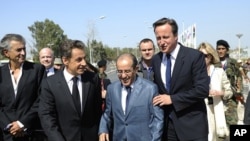
French and British leaders promised economic and political support to Libya's new leadership during a landmark visit to the North African country Thursday. They also vowed to continue NATO airstrikes to eradicate the last remnants of the Moammar Gadhafi regime.
Warm welcome
French President Nicolas Sarkozy and British Prime Minister David Cameron received a hero's welcome in Libya, in the first visit by Western leaders since the toppling of Moammar Gadhafi's regime. Both leaders applauded the Libyan people for causing the change.
"This was your revolution, not our revolution. It was those brave people in Misrata, in Benghazi, in Brega, in Zlitan, in Tripoli, in the Nefusa mountains who were incredibly brave in removing the dreadful dictatorship of Gadhafi and I pay tribute to those people throughout Libya today," said Cameron.
The two men visited both the capital, Tripoli, and the eastern city of Benghazi, touring a hospital and talking with members of Libya's rebel-led interim administration.
At a news conference, Cameron and Sarkozy vowed to support the new government and said NATO will continue airstrikes to remove the last holdouts of Gadhafi's loyalists. They called on the former Libyan leader and his supporters to turn themselves in.
"The message I think to Gadhafi and all those still holding arms on his behalf is 'it is over, give up,' the mercenaries should go home, those who still think Gadhafi has any part in any part of government of any part of this country should forget it," Cameron stated.
Unfreeze assets
Cameron said he will introduce a draft resolution at the United Nations calling for the release of billions of dollars in frozen Libyan assets. And while both leaders said those who committed crimes should be brought to justice, they urged forgiveness as the country moves from war to peace.
Sarkozy urged Libyans to look to the future and to avoid vengeance and score settling. Leaders of the interim administration also have urged national reconciliation.
France and Britain spearheaded NATO's first European-driven military campaign in Libya. Although the Europeans received mixed reviews for their performance, they were widely credited with seeing it to a successful conclusion.