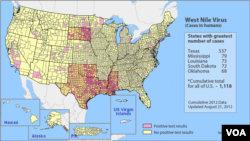
AUSTIN, Texas — Officials in the southwest U.S. state of Texas are tracking the spread of the West Nile virus, which has killed 21 people in the state so far this year and has sickened nearly 700. While the Dallas metropolitan area has had the most cases, the disease is cropping up all across the state.
Technicians in the state's mosquito laboratory are examining mosquito corpses sent from all over Texas, at the Texas Department of Health Services Laboratories in the capital of Austin.
State Laboratories Director Grace Kubin said technicians use animal tissue that is susceptible to West Nile virus to test the mosquito samples.
“We add in, essentially, the ground-up mosquitoes," said Kubin. "We have to grind them up; that releases the virus. And now we have that in a liquid form and we can use that to infect the cells.”
Kubin said the tests provide results within 48 hours so the lab can advise local officials on what action to take.
Mosquitoes aren't born with West Nile virus. They generally get it from biting birds that are infected.
Right bird, right time
To ingest the virus, mosquitoes need to find, so to speak, the right bird at the right time, according to Texas State Veterinarian Tom Sidwa. Some birds survive the virus.
“The birds only have the virus remaining in their blood from one to four days after they get infected. Then they have life-time immunity, so you have to find that bird that has the virus in its blood stream," said Sidwa.
West Nile cases in U.S.
From the Austin command center, Sidwa manages the state effort to track the West Nile outbreak. He said his team got an early warning months ago from routine testing of donated blood.
“This year we got advance notice that there was activity by virtue of that testing and people who were donating blood testing positive for West Nile. That does not mean they are sick. Some of them may be, but they have the virus in their system,” he said.
Most infected people unaware of it
Sidwa said most infected people are unaware of it. Symptoms can include fever, headache and feeling tired. For the small percentage whose brains are affected by the virus, it can be debilitating and even deadly.
“The way it manifests is everything from 80 percent of the people with no symptoms, to 20 percent with a lesser disease, and roughly one percent - or one in 150 - will develop the severe neurological form of the disease,” said Sidwa.
As the hot weather subsides in the weeks ahead, Sidwa said he expects the number of reported West Nile cases to taper off. And he said what has been learned this year will help in dealing with future outbreaks.