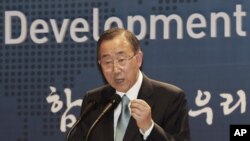
U.N. Secretary-General Ban Ki-moon has urged North and South Korea to ease tensions on the peninsula.
Ban's comments came during a meeting Monday with South Korean Foreign Minister Kim Sung-hwan in Seoul. "The most important thing is that the countries concerned, North and South Korea, should solve the problems through dialogue and widen exchanges and cooperation between the two countries," he said.
Cross-border relations have worsened in recent months. The North has threatened what it calls a "sacred war" against the South's conservative government for alleged insults to, and plots against, its government.
Pyongyang is also struggling with the devastation of floods that killed at least 169 people, left hundreds missing and washed away or inundated more than 65,000 hectares of cropland. Ban, a former South Korean foreign minister, said the United Nations was committed to continue its emergency aid to the North.
"At the U.N., we are concerned about various humanitarian crises in North Korea. Especially, we are concerned about the youth health issue and damage from recent drought and floods. The U.N. will pay close attention to these issues, and U.N. humanitarian organizations have been providing necessary support to North Korea," Ban stated. "We will continue to expand it."
The world body and other international organizations are providing emergency items, such as tents. But North Korean officials say they are not reaching people in some flooded areas because access to roads and railways has not been restored.
Ban's comments came during a meeting Monday with South Korean Foreign Minister Kim Sung-hwan in Seoul. "The most important thing is that the countries concerned, North and South Korea, should solve the problems through dialogue and widen exchanges and cooperation between the two countries," he said.
Cross-border relations have worsened in recent months. The North has threatened what it calls a "sacred war" against the South's conservative government for alleged insults to, and plots against, its government.
Pyongyang is also struggling with the devastation of floods that killed at least 169 people, left hundreds missing and washed away or inundated more than 65,000 hectares of cropland. Ban, a former South Korean foreign minister, said the United Nations was committed to continue its emergency aid to the North.
"At the U.N., we are concerned about various humanitarian crises in North Korea. Especially, we are concerned about the youth health issue and damage from recent drought and floods. The U.N. will pay close attention to these issues, and U.N. humanitarian organizations have been providing necessary support to North Korea," Ban stated. "We will continue to expand it."
The world body and other international organizations are providing emergency items, such as tents. But North Korean officials say they are not reaching people in some flooded areas because access to roads and railways has not been restored.