



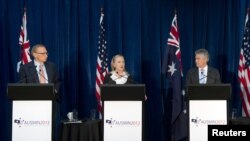
The United States vowed continued military cooperation with Australia, as the two countries opened annual defense talks in Perth, Australia on Wednesday.
Defense Secretary Leon Panetta said in the summit's opening remarks that U.S.-Australia relations were an important part of Washington's strategic pivot to the Asia-Pacific.
"Our biggest challenge now is, as we rebalance to the Pacific, is to try to work with allies like Australia to try to help us in that effort, so that we can do everything possible to promote security," he said.
Panetta was joined by Secretary of State Hillary Clinton for the annual high-level talks, the first since the U.S. announced its new Asia policy last year.
As part of the plan, 2,500 U.S. troops will be deployed to a joint military base in northern Australia. This week's talks were expected to focus on increased U.S. access to Australian navy bases and bombing ranges.
Australian Defense Minister Stephen Smith welcomed the first deployment of U.S. marines earlier this year to a base in the northern Australian city of Darwin. He said talks have begun on giving the U.S. more access to Australian ports.
The expanded U.S.-Australian defense ties come as China becomes increasingly assertive with its neighbors over territorial rights in the South China Sea and other regional waters.
Washington has denied that its new focus on Asia is meant to contain the rise of China, but Beijing remains unconvinced.
Defense Secretary Leon Panetta said in the summit's opening remarks that U.S.-Australia relations were an important part of Washington's strategic pivot to the Asia-Pacific.
"Our biggest challenge now is, as we rebalance to the Pacific, is to try to work with allies like Australia to try to help us in that effort, so that we can do everything possible to promote security," he said.
Panetta was joined by Secretary of State Hillary Clinton for the annual high-level talks, the first since the U.S. announced its new Asia policy last year.
As part of the plan, 2,500 U.S. troops will be deployed to a joint military base in northern Australia. This week's talks were expected to focus on increased U.S. access to Australian navy bases and bombing ranges.
Australian Defense Minister Stephen Smith welcomed the first deployment of U.S. marines earlier this year to a base in the northern Australian city of Darwin. He said talks have begun on giving the U.S. more access to Australian ports.
The expanded U.S.-Australian defense ties come as China becomes increasingly assertive with its neighbors over territorial rights in the South China Sea and other regional waters.
Washington has denied that its new focus on Asia is meant to contain the rise of China, but Beijing remains unconvinced.
Some information for this report was provided by AP and AFP.