


As Libyan leader Moammar Gadhafi faces defeat at the hands of a popular uprising, he is still well-regarded across much of Africa for his legacy of generosity.
Television images revealed the treasures of a decadent lifestyle, including gold-plated handguns and an indoor swimming pool.
But beyond his personal wealth, the government of Colonel Gadhafi also invested heavily in East Africa.
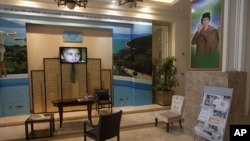
A Libyan-financed hotel towers over Sudan's capital, Khartoum, and has been nicknamed Gadhafi's egg because of its unique shape. Other Libyan luxury hotels stand tall in the capitals of Kenya, Rwanda and Uganda.
The country also has been one of the biggest contributors to the African Union as well as the African Development Bank.
As Colonel Gadhafi's reign comes to an end, this legacy of investment may unravel.
“Libya now needs to spend its money at home in needs resources both for reconstruction, not only from the damage from the war, but also from the lack of investment in Libya, the neglect during Gadhafi's almost 42 years in power," said J. Peter Pham, the Director of the Africa Center at the Atlantic Council in Washington. "So I think a lot of money will have to come home, so there probably will be a liquidation of many of these assets.”
Countries in East Africa have frozen Libyan assets, in accordance with a United Nations resolution.
But efforts are already underway to unlock the funds so they can be used by anti-Gadhafi forces.
Kenyan government spokesman Francis Mwaka says Kenya is aware of the potential that investments will be pulled, but does not think it will have a major impact.
“We are not going to have anything dramatic, anything serious or radical change, but legally, the property of the Libyan people will belong to the Libyan people according to the contracts, the way they were signed and the protocols,” said Mwaka.
Kenya implicitly recognized Libya's Transitional National Council in a statement last week that noted the “impending collapse” of the Gadhafi government.
Kenya's neighbor, Uganda, on the other hand has still not acknowledged the rebels' authority.
Ugandan government spokesperson Fred Opolot explains that decision.
“First and foremost, the government of Uganda has really continuosly reiterated that the Uganda's foreign policy is built on the principles of relations with states and not with individuals," he said. "And indeed, Uganda has maintained cordial relations with Libya and shall continue.”
Libya has invested $375 million in Uganda through the multi-billion dollar Libyan Africa Investment Portfolio. And Libyan companies have taken shares in the Ugandan telecom and banking sectors.
Given a long and lucrative history with Libya, Uganda's reluctance to recognize the NTC
is not unexpected.
Uganda's position is also in line with the African Union, which has been waiting for the prospective Libyan government to take shape before acknowledging its authority.
But Pham of the Atlantic Council says that policy may hurt future relations with Libya's new leadership.
“There's going to be a lot of resentment to Africa, both because of money that's been spent there and secondly because the African Union and many African leaders, with a few notable exceptions, stood by Gadhafi instead of with the Libyan people,” said Pham.
Pham says that it is also possible Libya will focus its foreign policy more on the Arab League, which supported the NATO air campaign backing rebel fighters.
Whatever the outcome of the war, it seems unlikely that the new Libyan leaders will envision as strong a kinship with the continent as a man who once declared himself Africa's "king of kings."