



Editor's note: this story was translated from the original VOA Kurdish article.
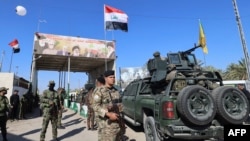
Iraqis expressed cautious optimism Friday after government forces entered Jurf al-Sakhar for the first time in 12 years. There were no reported clashes.
Prime Minister Ali al-Zaidi described the entry as a return to state control over a strategic town long dominated by an Iran-backed militia.
The deployment, carried out under al-Zaidi’s direct supervision, followed days of tension and threats of confrontation with Kataib Hezbollah, the powerful militia that has controlled the area since 2014.
The operation involved federal police, two brigades of the Popular Mobilization Forces (PMF), energy police and counterterrorism units.
For some residents, the peaceful deployment offered hope that years of insecurity and displacement might finally be coming to an end.
“So far, everything is good. The situation is calm,” resident Wissam Daghiri told VOA. “The security forces have arrived; they understand the situation and have adapted to it. Our relationship is good. There is no sound of gunfire, thank God, and that is exactly what we want.”
Daghiri said residents also hoped the operation would pave the way for displaced families to return to their homes and communities.
Another resident, Mazen Mahmoud, welcomed the security forces' arrival.
“We thank our security forces. They have been very cooperative and friendly with us, and there have been no disagreements between us,” Mahmoud told VOA. “We hope, God willing, that peace will return.”
Government declares a new chapter
Iraqi officials portrayed the deployment as a significant step toward restoring government authority over territory controlled by armed groups operating outside the state's effective command.
“Today is a historic moment in which the Iraqi army proves that it is the protector of the country and its security,” said Sabah al-Numan, spokesperson for Iraq's commander-in-chief of the armed forces.
He described the operation as an ongoing replacement and redeployment of personnel, adding that a new phase focused on public services would follow.
In a video statement after the deployment, al-Zaidi declared that “no force should remain outside the state.”
Jurf al-Sakhar, southwest of Baghdad, has been under the control of Kataib Hezbollah since Iraqi forces and allied militias recaptured the area from Islamic State militants in 2014.
Its status has become a test of Baghdad's ability to assert authority over powerful Iran-aligned armed factions, some of which operate within Iraq's official security structures.
The government has also been investigating allegations of illegal oil trafficking throughout the area. Iraqi officials have reported identifying suspected oil-smuggling operations using satellite imagery, although the full extent of the alleged activities remains unclear.
Questions over militia influence
Despite the peaceful entry of government forces, some observers question whether the arrangement represents a genuine transfer of authority or merely a reorganization of armed factions under official command structures.
The agreement reportedly involved Hadi al-Amiri, head of the Badr Organization, and an influential figure within the PMF.
Critics fear that militia-linked networks could retain influence through PMF units or their connections within the federal police, allowing the same armed groups to maintain effective control under a different administrative arrangement.
The United States has also called on Baghdad to confront Iran-aligned militias.
“The United States expects Prime Minister Al-Zaidi to hold Iran-aligned militias accountable for engaging in violent and destabilizing activities throughout Iraq and the entire region,” a State Department spokesperson told VOA earlier this week.
The spokesperson accused the militias of undermining Iraq's sovereignty, weakening its economy and diverting Iraqi resources through corruption for their own benefit and that of Tehran.
Displaced families await answers
Beyond the immediate security arrangements, the future of Jurf al-Sakhar's displaced population remains a major unresolved issue.
Thousands of residents have been unable to return since 2014. Estimates of the displaced population vary, with some local accounts citing 120,000 people and other assessments placing the figure substantially higher.
Elizabeth Tsurkov, a researcher on Iraqi affairs who was abducted by Kataib Hezbollah in 2023, told VOA that Jurf al-Sakhar's problems extend far beyond allegations of oil smuggling.
She pointed to allegations of sectarian targeting, enforced disappearances and other serious human rights violations against its Sunni population by the Shiite militia.
Tsurkov called for genuine government control, investigations into suspected mass graves and weapons-storage facilities, and the return of displaced residents, whose number she estimated at between 120,000 and 180,000.