



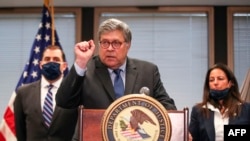
U.S. Attorney General William Barr authorized federal prosecutors to investigate “substantial allegations” of voting irregularities in last week’s election, a move that prompted the Justice Department official who oversees election crimes to step down from that position.
Barr issued a memo to U.S. attorneys on Monday, copies of which were obtained by multiple news organizations, that did not cite any specific instances of alleged fraud.
He said investigations “may be conducted if there are clear and apparently-credible allegations of irregularities that, if true, could potentially impact the outcome of a federal election in an individual State.”
Barr added, “While it is imperative that credible allegations be addressed in a timely and effective manner, it is equally imperative that Department personnel exercise appropriate caution and maintain the Department’s absolute commitment to fairness, neutrality and non-partisanship.”

Justice Department top election crimes prosecutor Richard Pilger said in an email to colleagues Monday he would “regretfully resign” after considering Barr’s memo “and its ramifications.” Pilger will remain in the department in another role.
Longstanding Justice Department policy has been to prohibit such investigations until election officials in each state certified their results in order to ensure there is not interference from the federal government.
States have until December 8 to conduct recounts or resolve election-related lawsuits, and the Electoral College will meet December 14 to formally select the presidential election winner based on last week’s voting.
Bob Bauer, attorney for the campaign of former Vice President Joe Biden, said in a Monday statement it is “deeply unfortunate that Attorney General Barr chose to issue a memorandum that will only fuel the ‘specious, speculative, fanciful or far-fetched claims’ he professes to guard against.”
“Those are the very kind of claims that the president and his lawyers are making unsuccessfully every day, as their lawsuits are laughed out of one court after another,” Bauer said. “But, in the end, American democracy is stronger than any clumsy and cynical partisan political scheme.”
President Donald Trump has not conceded the election, and has claimed, without providing evidence, that the voting process in multiple states was fraudulent.
Major news organizations have declared Biden the winner based on vote tallies released by states.