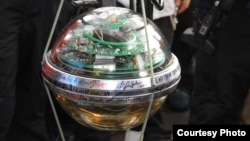
National Science Foundation scientists, engineers and drillers working on the deployment of IceCube in December, 2010, signed the last sensor before it was buried 2 kilometers deep in the Antarctic ice. (IceCube/NSF)
Sensors buried deep in the Antarctic ice have detected evidence of high energy particles from outside the solar system. The extraterrestrial discovery could usher in a new age of astronomy and greater understanding of the nature of the universe.
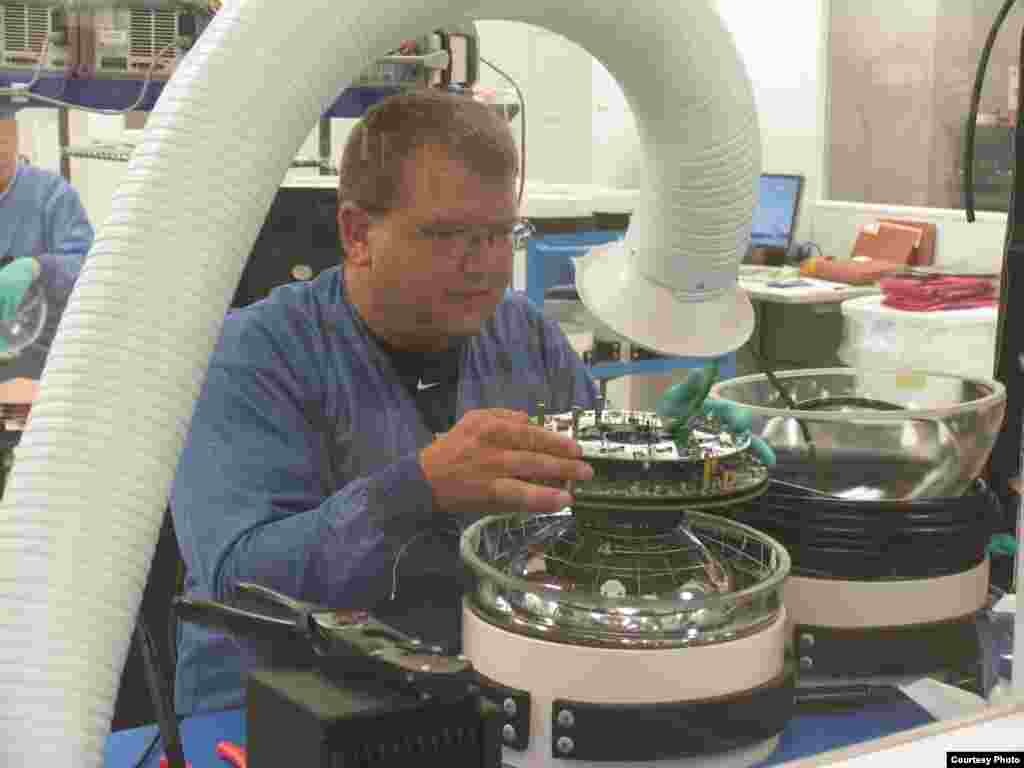
IceCube scientists and engineers assembled digital optical modules (DMOs) - instruments the size of basketballs - and installed them at depths of up to two kilometers under the ice.
Linked to computers by an extensive array of cables, DMOs collect raw data on neutrino activity in near real time by capturing the light emitted when neutrinos strike the ice.
The IceCube Laboratory
1/10The IceCube Laboratory at the Amundsen-Scott South Pole Station in Antarctica is the world's largest neutrino detector.(Sven Lidstrom, IceCube/NSF)
Sensors buried deep in the Antarctica ice have detected evidence of high energy particles from outside the solar system. The extraterrestrial discovery could usher in a new age of astronomy and greater understanding of the nature of the universe.
Show moreShow less
2/10IceCube used icebreakers to deliver heavy equipment from Sweden to the coast of Antarctica. (Chadden Hunter)
Sensors buried deep in the Antarctica ice have detected evidence of high energy particles from outside the solar system. The extraterrestrial discovery could usher in a new age of astronomy and greater understanding of the nature of the universe.
Show moreShow less
3/10Scientists began deploying neutrino detectors beneath 1,500 meters of ice starting in November of 1992. (Robert Morse/NSF)
Sensors buried deep in the Antarctica ice have detected evidence of high energy particles from outside the solar system. The extraterrestrial discovery could usher in a new age of astronomy and greater understanding of the nature of the universe.
Show moreShow less
4/10Once the detectors were deployed, cables were pulled to connect the sensors to IceCube Lab’s servers. (Freija Descamps/NSF)
Sensors buried deep in the Antarctica ice have detected evidence of high energy particles from outside the solar system. The extraterrestrial discovery could usher in a new age of astronomy and greater understanding of the nature of the universe.
Show moreShow less
5/10A technician at the University of Wisconsin-Madison Physical Sciences Lab works on one of the sensors of the IceCube detector. (IceCube/NSF)
Sensors buried deep in the Antarctica ice have detected evidence of high energy particles from outside the solar system. The extraterrestrial discovery could usher in a new age of astronomy and greater understanding of the nature of the universe.
Show moreShow less
6/10NSF scientists, engineers and drillers working on the deployment of IceCube in Dec. 2010, signed the last sensor before it was buried 2 kilometers deep in the Antarctic ice. (IceCube/NSF)
Sensors buried deep in the Antarctica ice have detected evidence of high energy particles from outside the solar system. The extraterrestrial discovery could usher in a new age of astronomy and greater understanding of the nature of the universe.
Show moreShow less
7/10Members of the IceCube Collaboration before the deployment of the last digital optical module (DOM), installed on Dec. 18, 2010. (Robert Schwarz, NSF)
Sensors buried deep in the Antarctica ice have detected evidence of high energy particles from outside the solar system. The extraterrestrial discovery could usher in a new age of astronomy and greater understanding of the nature of the universe.
Show moreShow less
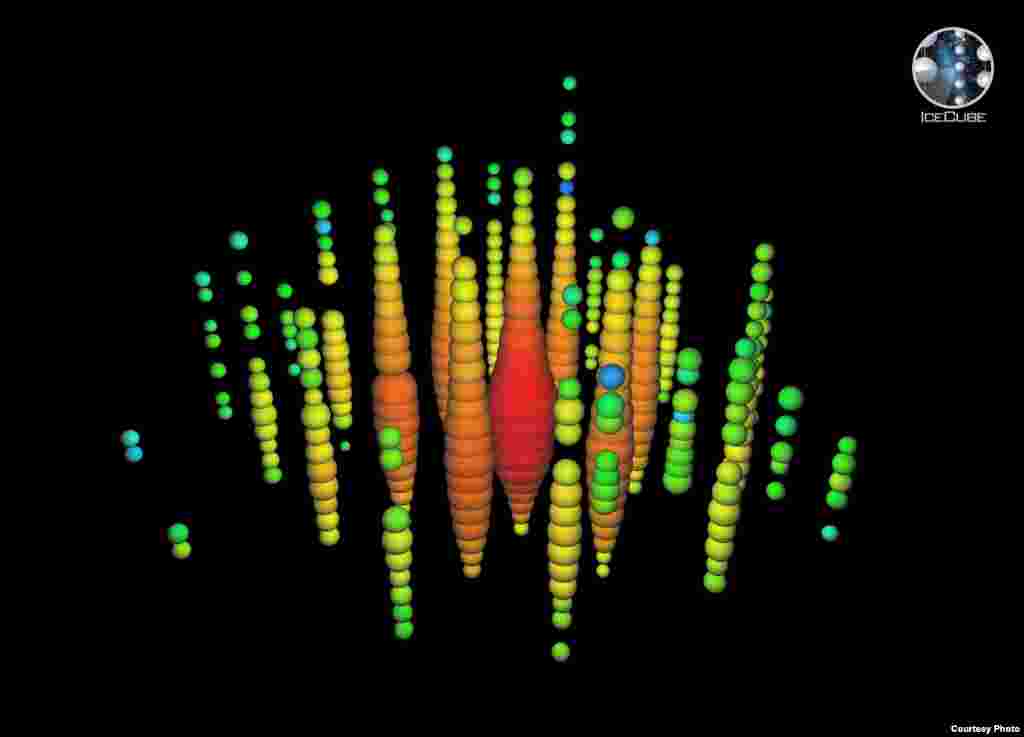
8/10This digital image shows the highest energy neutrino ever observed, with an estimated energy of 1.14 petaelectronvolts (PeV), detected by the IceCube Neutrino Observatory at the South Pole on Jan. 3, 2012. (IceCube Collaboration)
Sensors buried deep in the Antarctica ice have detected evidence of high energy particles from outside the solar system. The extraterrestrial discovery could usher in a new age of astronomy and greater understanding of the nature of the universe.
Show moreShow less
9/10Only two percent of Antarctica is not covered in ice. (Jim Haugen/NSF)
Sensors buried deep in the Antarctica ice have detected evidence of high energy particles from outside the solar system. The extraterrestrial discovery could usher in a new age of astronomy and greater understanding of the nature of the universe.
Show moreShow less
10/10The IceCube Lab under the stars. (Felipe Pedreros. IceCube/NSF)
Sensors buried deep in the Antarctica ice have detected evidence of high energy particles from outside the solar system. The extraterrestrial discovery could usher in a new age of astronomy and greater understanding of the nature of the universe.
Show moreShow less
Previous slide
Next slide
High energy neutrinos rare
These unimaginably tiny, nearly massless particles are the building blocks of the cosmos. They stream from the sun or Earth’s own atmosphere at near light speed. Billions pass through us every second without a trace.
But, these are low energy neutrinos. They are not what interest the 250 scientists from 11 countries working on IceCube.
Principal investigator and University of Wisconsin physics professor Francis Halzen says IceCube is scanning for high energy neutrinos from outside the solar system.
“What we want to see is a handful of events sent to us by the universe. We’ve finally discovered those.”
New research confirms powerful neutrinos
When the neutrinos interact with atoms inside the deep ice detectors, they sometimes give off puffs of light. In 2010, scientists detected two high energy neutrinos and then, last year, 26 more, including the most energetic neutrinos ever observed.
IceCube collaborator and University of Wisconsin physicist Nathan Whitehorn says analysis of that data, published in the journal Science, confirmed their earlier find.
“It was almost impossible without more data and data at lower energies to be sure that these two neutrinos that we found were part of a larger pattern indicating an extraterrestrial population, instead of some statistical fluke.”
Neutrinos ideal candidates for tracing origin of cosmic rays
Neutrinos have almost no mass and no electric charge, so they are unaffected by Earth’s magnetic fields.
They keep up speed and zip in a straight line through the solar system. That behavior is far different from the electrically charged cosmic rays, which rain down on our planet and are easily deflected by magnetic fields. Whitehorn says that makes them ideal candidates to track the origin of cosmic rays.
“We expect that anything that is making high energy cosmic rays, the most energetic phenomenon in the universe, whatever they are, will make neutrinos at the same time and if we are able to identify the origin of these high energy neutrinos, they will provide some very powerful clues about the origin of the highest energy cosmic rays.”
Scientists have been trying to solve this mystery for more than a century, and they hope these extraterrestrial messengers can point the way.