



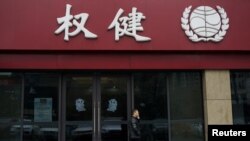
China will step up its fight against "irregularities" in the sale of health care products after a series of scandals in the industry in recent months,
state media reported Thursday, citing senior officials.
Zhang Mao, minister at the State Administration for Market Regulation, told China Central Television in an interview that the country's health sector was "rampant with irregularities" and plans were underway to put it under greater scrutiny.
China launched a 100-day campaign at the start of the month to crack down on illegal advertising and other violations in the industry following a number of high-profile cases.
"Recently, serious problems involving the health products market have been exposed, such as fake promotions, illegal advertising and deceiving consumers," the China Daily newspaper quoted Zhang as saying at the launch the campaign.
Earlier this month, police arrested the founder of Quanjian Nature Medicine Technology, a traditional Chinese medicine firm, amid allegations of fraudulent practice following the death of a 7-year-old girl who had used the company's products as part of her cancer treatment.
Market regulators are also investigating local branches of Infinitus, a multibillion-yuan Chinese company, after it was accused of selling products that damaged a child's heart.
Many of the recent investigations have focused on "multilevel marketing" schemes in which members buy products from the company and then sell them on. Though this "direct selling" is allowed in China, "pyramid selling" — which uses income generated from new members to pay off older members — has been banned.
Police in northern China's Hebei province said last week that they had launched an investigation into Hualin Acid-Base Technology, a local health product company accused of operating a pyramid selling scheme and misleading customers.
Last week, the Guangdong provincial government in southeastern China also summoned 32 locally registered "direct sales" firms — including Infinitus and the U.S.-based Amway — to issue a warning against malpractice. The firms agreed to sign a pledge not to deceive consumers about the therapeutic benefits of their products, according to the official Xinhua news agency.