Accessibility links

Breaking News

NASA’s New Space Capsule Has Flawless First Flight

update
NASA’s New Space Capsule Has Flawless First Flight
please wait

No media source currently available

0:00 0:02:31 0:00

NASA’s New Space Capsule Has Flawless First Flight

NASA’s new generation spacecraft Orion, designed for manned deep-space journeys, has successfully orbited the Earth on its maiden flight, while the agency’s scientists tested numerous systems. NASA officials hope Friday's mission will usher in a new era of flights with astronauts on board, including a visit to Mars.

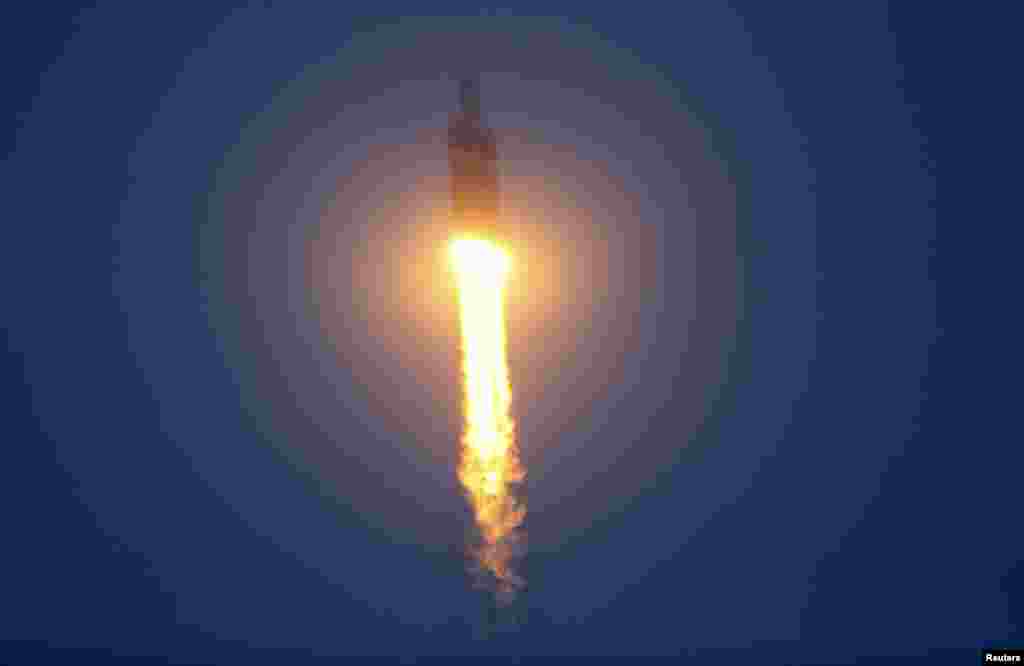
After a one-day delay, due to minor problems with a stubborn valve and a strong wind, the huge Delta IV Heavy rocket blasted off from Florida's Kennedy Space Center at 7:05 local time, carrying the new Orion capsule, still without the human crew.

The flight lasted 4 hours and 24 minutes. The spacecraft orbited the Earth twice before splashing into the Pacific Ocean.

At a press conference after the splashdown, NASA's Orion program manager Mark Geyer said it was hard to have a better day than today.

“It’s a difficult mission. It’s a tough environment to fly through. Its tough objectives that we set up for this flight. But it appears that Orion and the Delta IV Heavy were nearly flawless. Great job by the team,” he said.

Geyer said this is the first system secure enough to carry humans into deep space since Apollo 17, launched in 1972.

Orion's elongated orbit took it through the dangerous layer of highly-charged subatomic particles called the Van-Allen belt, where NASA engineers tested the spacecraft’s resistance to cosmic radiation.

Upon re-entry into the atmosphere, the capsule was traveling almost 30 times faster than the speed of sound, while the temperature of its heat shield rose to 2,200 degrees Celsius.

The capsule was built by Lockheed Martin. Its Orion program manager, Michael Hawes, said the corporation is already working on the next design, and data acquired today will be very valuable.

“There is an awful lot that is already going, but we’ll learn just an enormous amount from what we did today and when we get all that data back that will be a big deal for us,” said Hawes.

NASA says in the future, the Orion capsule will fly on top of a more powerful rocket, the Space Launch System. In 2018, NASA plans to send the spacecraft to circumnavigate the moon, while the first flight with astronauts is planned for 2021.

Orion Passes First Test With Flying Colors

The Delta IV Heavy rocket with the Orion spacecraft lifts off from the Cape Canaveral Air Force Station in Cape Canaveral, Florida, Dec. 5, 2014.
1/8 The Delta IV Heavy rocket with the Orion spacecraft lifts off from the Cape Canaveral Air Force Station in Cape Canaveral, Florida, Dec. 5, 2014.
In this photo provided by NASA, the United Launch Alliance Delta 4-Heavy rocket, with NASA’s Orion spacecraft mounted atop, lifts off from the Cape Canaveral Air Force Station, Friday, Dec. 5, 2014.
2/8 In this photo provided by NASA, the United Launch Alliance Delta 4-Heavy rocket, with NASA’s Orion spacecraft mounted atop, lifts off from the Cape Canaveral Air Force Station, Friday, Dec. 5, 2014.
The Delta IV Heavy rocket with the Orion spacecraft lifts off from the Cape Canaveral Air Force Station, Dec. 5, 2014.
3/8 The Delta IV Heavy rocket with the Orion spacecraft lifts off from the Cape Canaveral Air Force Station, Dec. 5, 2014.
NASA Administrator Charles Bolden, left, and his wife Jackie watch as the Delta IV Heavy rocket with the Orion spacecraft lifts off from the Cape Canaveral, Dec. 5, 2014.
4/8 NASA Administrator Charles Bolden, left, and his wife Jackie watch as the Delta IV Heavy rocket with the Orion spacecraft lifts off from the Cape Canaveral, Dec. 5, 2014.
This photo provided by NASA-TV, shows the view from the Orion spacecraft atop a United Launch Alliance Delta 4-Heavy rocket as it climbs to orbit during the first test flight, Friday Dec. 5, 2014.
5/8 This photo provided by NASA-TV, shows the view from the Orion spacecraft atop a United Launch Alliance Delta 4-Heavy rocket as it climbs to orbit during the first test flight, Friday Dec. 5, 2014.
In this frame grab from NASA-TV, the Orion spacecraft descends before splashing down in the Pacific Ocean, Friday, Dec. 5, 2014.
6/8 In this frame grab from NASA-TV, the Orion spacecraft descends before splashing down in the Pacific Ocean, Friday, Dec. 5, 2014.
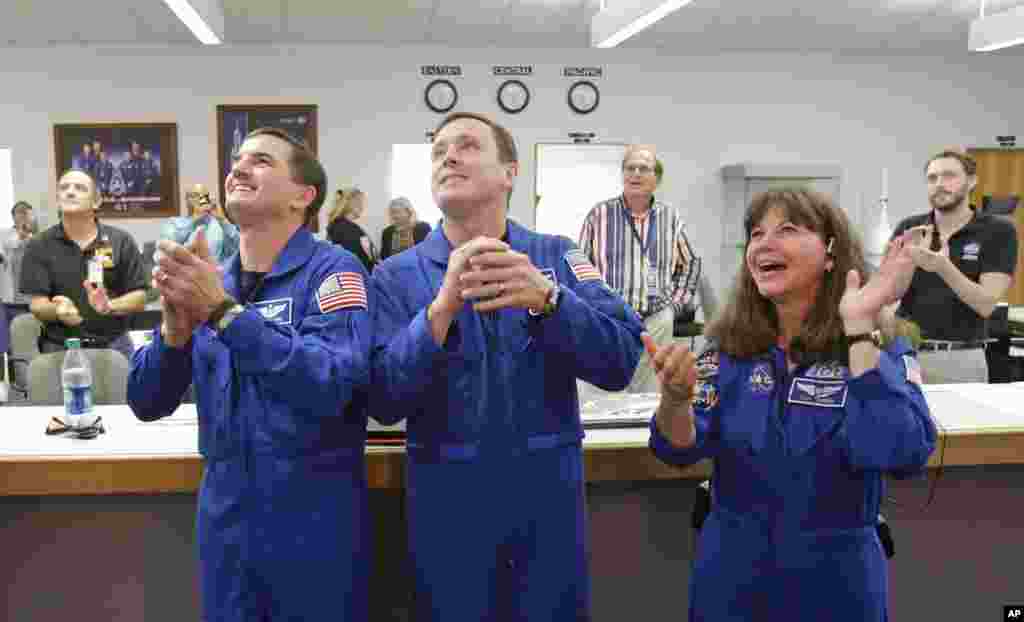
NASA astronauts, from left, Rex Walheim, Jack Fischer and Cady Coleman, cheer as they watch the landing of the Orion test flight on a television at the Press Site at the Kennedy Space Center, Friday, Dec. 5, 2014.
7/8 NASA astronauts, from left, Rex Walheim, Jack Fischer and Cady Coleman, cheer as they watch the landing of the Orion test flight on a television at the Press Site at the Kennedy Space Center, Friday, Dec. 5, 2014.
In this frame grab from NASA-TV, the Orion capsule floats after splashing down in the Pacific Ocean, Friday, Dec. 5, 2014.
8/8 In this frame grab from NASA-TV, the Orion capsule floats after splashing down in the Pacific Ocean, Friday, Dec. 5, 2014.
Previous slide
Next slide


This item is part of
XS
SM
MD
LG