Source of Contamination at Fukushima Nuclear Plant Unknown
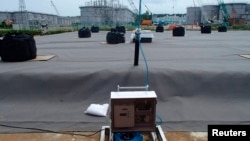
A leakage detective unit (C) and its detection punch unit on an underground water storage tank are seen at TEPCO's tsunami-crippled Fukushima nuclear power plant in Fukushima, in this undated photograph released by TEPCO on April 6, 2013.
TOKYO —
Fresh revelations about radiation contamination from the operator of the crippled Fukushima nuclear power plant and a government regulator are prompting new concerns in Japan.
What is expected to be a decades-long battle to halt radiation leaks and to clean up contaminated soil and water at the Fukushima-1 nuclear plant is back in the public eye following the release of new information this week.
The destroyed facility's owner, Tokyo Electric Power Company (TEPCO), says there have been significant increases in recent months in levels of radioactive cesium in the groundwater, as well as strontium and tritium offshore.
Meanwhile, the head of the recently established Japan Nuclear Regulatory Authority, Shunichi Tanaka, acknowledges contaminated water has probably been continually leaking into the Pacific Ocean since the plant was swamped by a tsunami triggered by a magnitude nine earthquake on March 11, 2011.
"The ocean continues to be contaminated to some extent, great or small,” Tanaka said, adding that that while it peaked at the time of the disaster two years ago, he thinks it has been continuing even after that.
Japan marks second anniversary of Fukushima disaster
Japan Marks 2nd Tsunami Anniversary
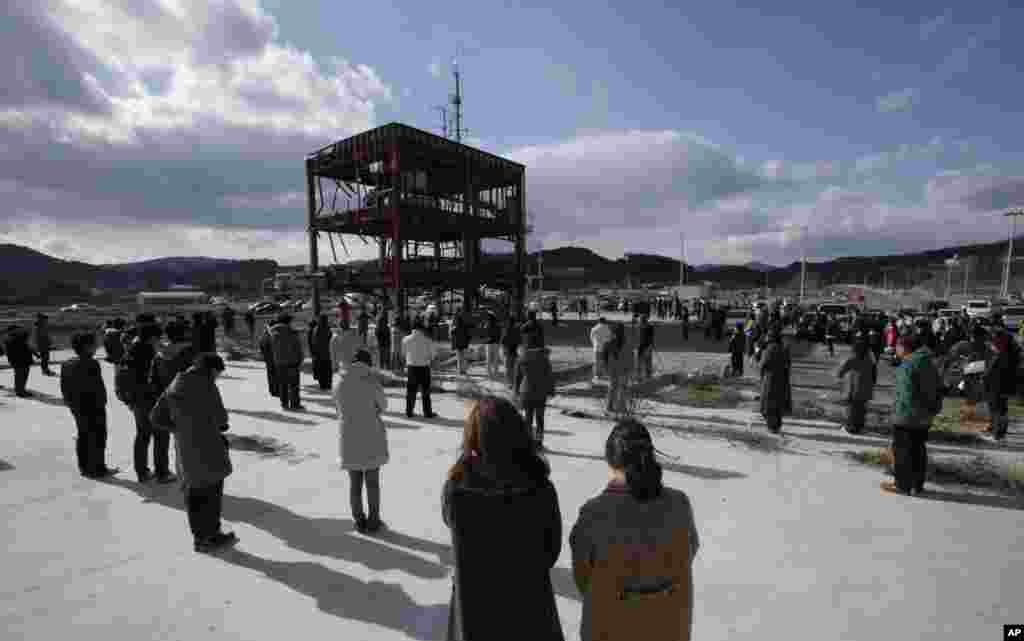
1/9People bow their heads in a moment of silence around what is left of a disaster control center devastated by the March 11, 2011 earthquake and tsunami, Minamisanriku, Miyagi prefecture, Japan, March 11, 2013.
Japan observed a moment of silence to mark the second anniversary of a devastating earthquake and tsunami that claimed nearly 19,000 lives and caused the worst nuclear accident since the 1986 Chernobyl disaster.
Show moreShow less
2/9Japanese Prime Minister Shinzo Abe bows to Emperor Akihito and Empress Michiko during the national memorial service for the victims of the March 11, 2011, earthquake and tsunami in Tokyo, March 11, 2013.
Japan observed a moment of silence to mark the second anniversary of a devastating earthquake and tsunami that claimed nearly 19,000 lives and caused the worst nuclear accident since the 1986 Chernobyl disaster.
Show moreShow less
3/9Japanese Emperor Akihito and Empress Michiko leave the national memorial service for the victims of the March 11, 2011 earthquake and tsunami in Tokyo, March 11, 2013.
Japan observed a moment of silence to mark the second anniversary of a devastating earthquake and tsunami that claimed nearly 19,000 lives and caused the worst nuclear accident since the 1986 Chernobyl disaster.
Show moreShow less
4/9People observe a moment of silence for the victims of the March 11, 2011 earthquake and tsunami during an event at a park in Tokyo, March 11, 2013.
Japan observed a moment of silence to mark the second anniversary of a devastating earthquake and tsunami that claimed nearly 19,000 lives and caused the worst nuclear accident since the 1986 Chernobyl disaster.
Show moreShow less
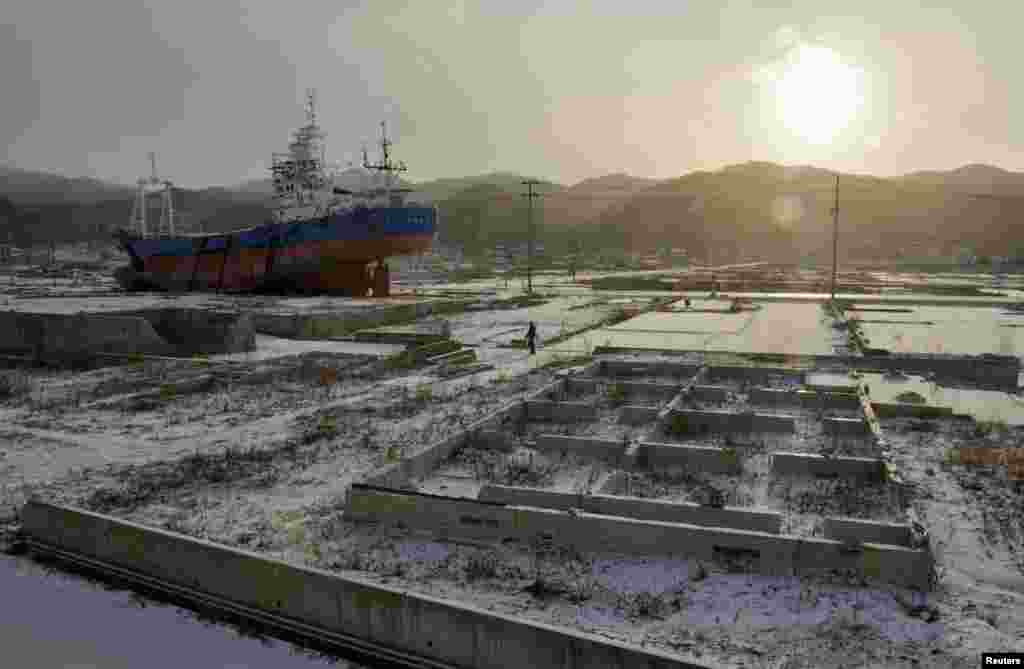
5/9A local resident and a dog walk near a ship brought ashore by the March 11, 2011 tsunami and earthquake in Kesennuma, Miyagi Prefecture, Japan, March 11, 2013.
Japan observed a moment of silence to mark the second anniversary of a devastating earthquake and tsunami that claimed nearly 19,000 lives and caused the worst nuclear accident since the 1986 Chernobyl disaster.
Show moreShow less
6/9The Netherlands (top) and Cuban baseball teams offer a silent tribute to victims of March 11, 2011 earthquake and tsunam, before their World Baseball Classic (WBC) second round game in Tokyo, March 11, 2013.
Japan observed a moment of silence to mark the second anniversary of a devastating earthquake and tsunami that claimed nearly 19,000 lives and caused the worst nuclear accident since the 1986 Chernobyl disaster.
Show moreShow less
7/9Buddhist monks chant sutras in front of the main entrance of Okawa Elementary School where 74 of the 108 students went missing after the March 11, 2011 tsunami in Ishinomaki, Miyagi prefecture, Japan, March 11, 2013.
Japan observed a moment of silence to mark the second anniversary of a devastating earthquake and tsunami that claimed nearly 19,000 lives and caused the worst nuclear accident since the 1986 Chernobyl disaster.
Show moreShow less
8/9Police officers search for the remains of those who went missing in the March 11, 2011 tsunami on the coastline in Ishinomaki, Miyagi Prefecture, northern Japan, March 11, 2013.
Japan observed a moment of silence to mark the second anniversary of a devastating earthquake and tsunami that claimed nearly 19,000 lives and caused the worst nuclear accident since the 1986 Chernobyl disaster.
Show moreShow less
9/9A visitor lights a candle to remember the victims of the March 11, 2011 tsunami and earthquake, in Tokyo, March 10, 2013.
Japan observed a moment of silence to mark the second anniversary of a devastating earthquake and tsunami that claimed nearly 19,000 lives and caused the worst nuclear accident since the 1986 Chernobyl disaster.
Show moreShow less
Previous slide
Next slide
Junichi Sato, the program director in Japan for the environmental group Greenpeace, said in a interview with VOA that this is fresh cause for concern.
“Mainly, in the past, the contamination was caused by the intentional release of the contaminated water," said Sato. "That's what they have been saying that's the reason for the contamination. But what we are talking about is now the groundwater leakage which means a continuous contamination of the oceans.”
According to Sato, Greenpeace has been asking TEPCO since May to allow a third party to enter within the five kilometer exclusive zone to independently sample the radiation level in coastal waters.
Nuclear regulator Tanaka admits the source of the leak is not known nor does anyone have a plan to stop it.
Tanaka, speaking to reporters, says there is no “rock solid solution," and if there was one then they would go ahead and implement it. Officials and TEPCO, he said, will likely have resort to “trial-and-error” methods to attempt to source and solve the problem.
Meanwhile, the Kyodo news agency reports that a contractor for the massive cleanup operation has discharged 340 tons of radioactive water into a Fukushima river. Local governments have complained about the disposal, saying they were not told about it in advance, but Kyodo says the contractor, JDC Corporation, dumped the contaminated water only after being told that the Japan Atomic Energy Agency had explained the action to relevant local officials. The river is a source of water for agriculture in the prefecture which is one of Japan's major sources of rice and other crops.
Sato at Greenpeace is among those lamenting that the fresh revelations regarding radiation contamination are receiving scant notice in Japanese newspapers and television broadcasts.
“Because it's been already two years and four months since the disaster, the government and also the media wants to play bad news quite low because they think that doesn't help the people in Fukushima or the recovery of Fukushima," he said. "We want to argue that unless you give the proper information, the correct information, the recovery of Fukushima can never happen.”
The meltdowns of three reactors at the Fukushima-1 plant has had severe repercussions for the nuclear power industry in resource-poor Japan. Before the 2011 disaster, the heavily industrialized island nation was dependent on nuclear power for nearly one-third of its energy needs.
All but two of Japan's working reactors remain idle. They must meet stricter government safety standards before receiving permission to again generate electricity for the world's third largest economy.